Top Cinema Career Options After 12th: What’s Best for You
Imagine a world in which your favorite movies may make you release your imagination. This is a question that leaves several high school seniors with a lot to think about the cinema industry. The modern entertainment industry is full of technical, artistic, and managerial roles that can serve a wide spectrum of interests, talents, and ambitions other than acting and directing.
The movie industry is growing unparalleled and the introduction of digital platforms has created a whole new opportunity. You might have a niche in this vibrant business with or without the inherent talent to tell stories, capture images, produce music, develop, perform, and manage.
Once you complete high school, this blog will assist you in making up your mind about the Cinema Career Options after 12th grade that you want to work.
Reasons to do Film-Making Courses After 12th?
The filmmaker uses cinematography, editing, music, dance, scripting, and directing; the filmmaker uses all the tools in the toolbox when they come together to tell a story. The students who decide to pursue their studies in filmmaking after high school in order to understand the film production process fully should concentrate on any of the above-mentioned areas of creativity.
The courses, such as those we are planning to discuss today, are a better way to prepare students for the difficult and gratifying career in film by instructing them not only in the theory of the craft but in its practical aspects.
Must Read: How to Be a Film Director: Key Skills, Types of Classes, Income
What are the Top Cinema Career Options after 12th?
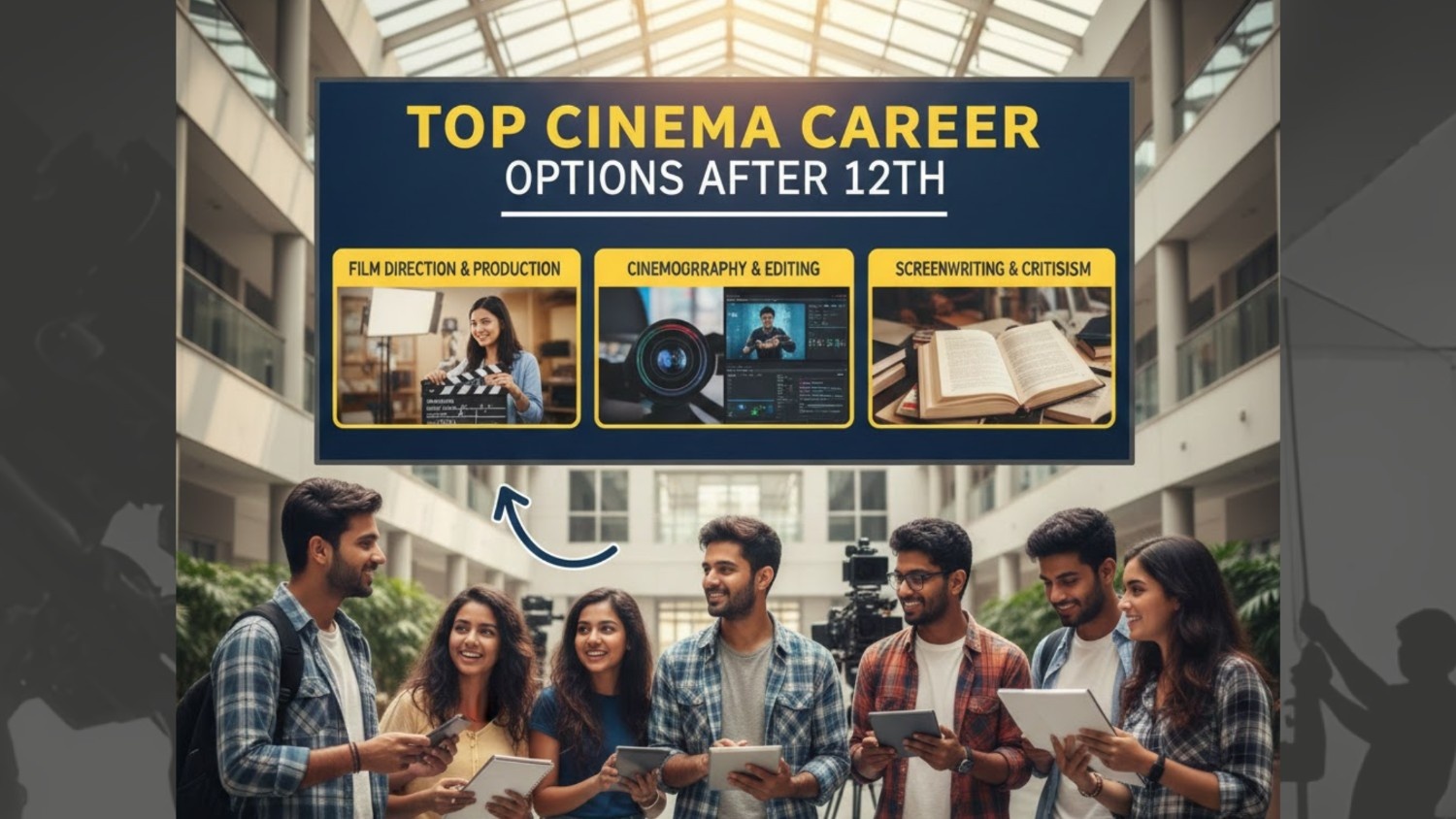
After high school, students who want to pursue cinematography have a number of courses available to them. Students go through a range of Cinema Career Options after 12th, and these choices include those given below.
Film Direction
Students who want to be film directors have an exciting task of learning the ins and outs of filmmaking A to Z. They follow an emotional and visual journey with the audience with the help of the translated screenplay. The director has been assigned to every single part of the production process, starting with the earlier planning phases (such as casting and location scouting), and on to the intricate post-production editing.
They also work very hand in hand with the actors to make the characters come alive, and the cinematographer and other members of the team, so that their creative vision is achieved in the film. Because it involves leadership, technical and artistic vision, the work of the film director is also pivotal in ensuring that the movies people watch will be remembered by them forever.
Cinema Career Options: Script Writing

Future writers will make use of this as they will know how to build stories that are loved by the audience. They breathe life into characters through stories, plots, and dialogues. The products of the labour of the scriptwriters will be films, TV shows, and digital media as they transform their scripts into other forms.
Book Now →
Their screenplays are the blueprint to any film; they define how the director, actors, and crew will play their roles and duties. It is not only that a good cinematographer is informed about the way the plot will be developed, about the characters that will be formed, but he or she is also endowed with the gift of language and is able to express the best ideas and emotions.
Must Read: Cinema Career Options in 2026: Paths, Pay, and Growth You Should Know
Cinema Career Options: Cinematographer
Cinematographers are the visual planners of the film, and they control photography. It is, therefore, their duty to capture the scene, which defines the aesthetics of the film. The professionalism of the cinematographers in lighting, composition, and camerawork will help them meet the vision of the director. Each scene is carefully shot in advance through the arrangement of camera angles, lenses, and lighting to suit the tone and mood of the story.
Do you want free career counseling?
Ignite Your Ambitions- Seize the Opportunity for a Free Career Counseling Session.One should have an extraordinary level of observation and a thorough knowledge of visual narration. Cinematographers are artists, and their primary role is to make each frame of a movie look good and to make the change between the frames seamless.
Cinema Career Options: Film Making
The filmmakers begin with unfinished video and assemble it to form a finished product that will be polished and entertaining. The producers of the film, along with the director, attempt to convey the intentions of the filmmaker in the tone and atmosphere of the film.
Then, they choose scenes and shots to determine the direction in which the story will alternate. To produce the required mood, editors add music, visual and sound effects, slowing down the tempo and changing the time.
The overall look and feel of the movie is achieved by a combination of technical mastery and artistic instincts. To be able to convert hours of raw material into a perfect finished product that audiences grow captivated with throughout the movie is a fine feature of an experienced film editor.
Cinema Career Options: Acting
The opportunities of getting a role in the industry are plenty after Cinema Career Options after 12th who decide to venture into the industry, be it in feature films, television shows, or stage shows. Actors resort to their bodies and faces to introduce the emotions of the characters to bring the drama to life. To make their characters appear realistic and lively, they talk to the directors to get to know their background, their driving force and how they relate together.
The would-be performers are taught several techniques of managing their voice and body language. The art of acting is an ability that necessitates a combination of inborn talents, effort, and constant practice. The power of actors to become another personality and another scene is the key feature of a movie, and due to it, they can forever memorise their contribution to the narration.
Cinema Career Options: Video Editing
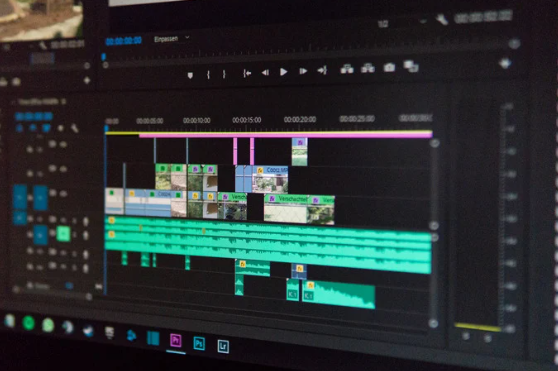
In the post-production stages of a movie, the video editors will be crucial. In this plan, they would be responsible for assembling and editing the video such that the outcome is what the director wants to see. To cut, reorganise sequences, modify colour tone, add special effects, and even a soundtrack, they use the most effective tools for editing. The cutting and transitioning are so detailed and add to the flow of the storyline.
It is a complicated process requiring expertise in the field of technology and an artistic feeling to find the right balance between the tempo, mood, and aesthetic appeal of a film. Good video editing makes it possible to deliver a film that has a polished and professional look and feel.
Last Thoughts: “Lights, Camera… Your Future!”
A decision to pursue a career in film right after high school is not merely about enjoying the field; it is also about pursuing your talents. Cinema is a vibrant, moving, and vast universe. Any person who has the artistic inclination can achieve success in the movie industry, whether they are interested in directing, acting, animation, handling production, or just creating beautiful pictures.
You should study as much as you can, and you should make that first step into the world where your dreams could come true. That is the most important thing when looking at Cinema Career Options after 12th.
Faqs on Cinema Career Options after 12th
1. Is it possible to enroll in cinema classes after 12th, even though I do not belong to an arts background?
Of course! The film industry is open to all academic disciplines,such as the arts, business, and science.
2. Is it a requirement to pursue a career in acting or filmmaking with experience?
Yes. It is important to be passionate and receptive to new knowledge.
3. Are cinema careers stable?
Talented people can also have a good future in the movie and digital media industries that are experiencing rapid growth.
4. What should I study after 12th to become a film director?
Visual effects (VFX), editing, sound design, cinematography, acting, and filmmaking are among the most popular ones.
5. What is the cinema course duration post 12th?
They take the form of short (3-6 months) to long (1-2 years) and even longer (degree programs, 3 years).
6. Would I be able to make it in the film industry without being an actor?
Yes. Some of the numerous behind-the-scenes jobs one can get in the business include directing, editing, animating, and producing sound.