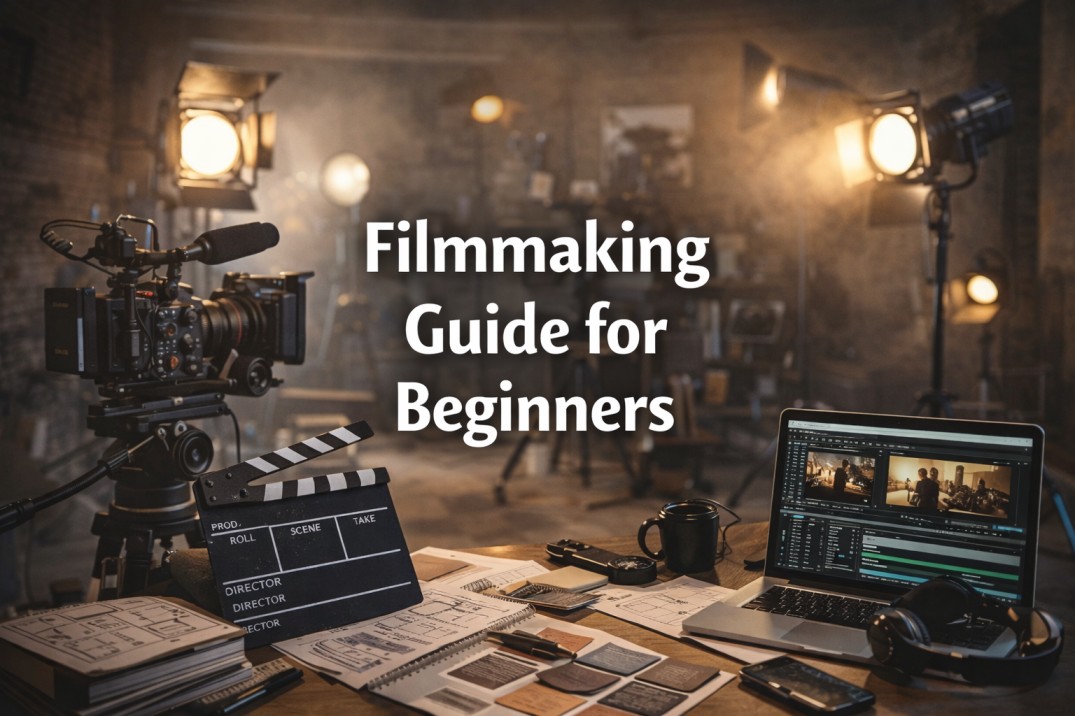
Step-by-Step Filmmaking Guide for Beginners 2026 Edition
Filmmaking is an ever-growing industry, driven by technology, trends of storytelling all over the globe, and the transforming pattern of consuming media by people. However, the essence of cinema does not change: it is the ability to convey human lives with the help of images, sound, and plot. As a beginner entering the field of filmmaking in 2026, it may be confusing, but dividing the process into unambiguous steps allows the process to be achievable and creatively fulfilling.
This is a Filmmaking Guide for Beginners through every process, starting with the formation of an idea to the final distribution, which can enable new people to know the entire work procedure in the production of a film.
How to Make Your First Movie
This is a Filmmaking Guide for Beginners that simplifies the whole process, from concept to release and is in a simple, beginner-friendly format.
1. Start With a Strong Idea
All movies start with something, which can be either a theme, a character, or even a question that a movie maker wishes to answer. Early on, perfection is not what you are looking to achieve. Instead, focus on clarity.
Ask yourself:
- What is my desired effect on the emotion?
- Why is this story meaningful?
- Who is my audience?
Write in one or two lines about your idea. This is what you make your logline, something you will go back to as the project progresses so as to keep your work on track.
2. Write the Script and Develop the Concept
After getting the idea, start to develop it into a narrative. This step will entail summarizing the main points, developing character lines, and determining how your story is going to be. The writing tools of the future in 2026 can be used to assist you when you are in a rut, but the creative choices should always be yours.
An average short-film script would be between 5 and 15 pages in length, with a feature script being between 90 and 120 pages.
Write your script in the conventional screenwriting format because it is simpler to read and comprehend by the actors and other workers.
3. Pre-Production: How To Plan Your Movie
The longest phase can be pre-production. It is where the film actually comes into form.
Book Now →
a. Budgeting
A student or amateur film needs some sort of a budget, even equipment rentals, props, transportation, food, and possible location rent. Be realistic and follow everything.
b. Storyboard and Shot Lists.
You can visualise your scenes before shooting, and therefore remain organised. The storyboards do not need to be fancy and the sketches can be as simple as they convey framing, movement and tone.
c. Casting
Select actors that know about the emotional needs of your characters. Auditions, self-test video and rehearsal will assist you in getting the good match.
Do you want free career counseling?
Ignite Your Ambitions- Seize the Opportunity for a Free Career Counseling Session.d. Location Scouting
Choose areas that give credence to the story, are practically appealing and can be dealt with in relation to their acoustics and lighting. Never accept a permission verbally.
e. Scheduling
Draw up a shooting schedule (call sheet) showing when things are to be arrived at, what scenes to be shot, what props are needed and what the weather is going to be like. Proper scheduling may save hours on the schedule.
4. Understand the Equipment
The technology of making films in 2026 is more accessible than ever. Mirrorless cameras, advanced smartphones, or small camera cinema can be used by beginners to shoot professional-quality footage.
Key equipment categories:
- Camera: Select the one depending on your budget and requirements.
- Lenses: Wide, telephoto and prime lenses are each used to produce various emotions, in terms of framing.
- Sound: Take external microphones- sound quality is the most important factor to overall credibility than most amateurs think.
- Lighting: Even commercial LED panels, reflectors and natural light can be used to create mood in a low-budget.
- Stabilisers: Tripods, gimbals, and sliders enhance the visual smoothness.
It is important to learn the basics, which are exposure, white balance, frame rate, and focus, before taking shots.
Must Read: CGI in Filmmaking: Evolution, Impact and Future Trends
5. Shooting Your Film
The point of planning and execution is at production. Always remember the following principles:
a. Stay Flexible though Adhere to the Shot List.
All of this can change on-site – light, noise, availability of actors. Change and still maintain the message of the film.
b. Communicate Clearly
Film production is a teamwork. Show decency, provide a clear Filmmaking Guide for Beginners, and ensure that the working environment is safe.
c. Capture Clean Sound
Monitor audio constantly. One of the most widespread issues of amateur movies is bad sound.
d. Get Multiple Takes
Although the initial recording could sound good, recording back up takes will guarantee that you will have a choice during editing.
e. Record B-Roll
The additional shots of places, things, and activities make the transitions and tempo in the final version better.
6. Post Production: How to edit your movie

Post-production is the synthesis of all creative aspects in order to include video, sound, music and colour.
a. Organise Footage
Establish the folders of scenes, audio and graphics. Label files in a clear way to prevent confusion.
b. Assemble the Rough Cut
Scene sequences are arranged in sequence as per the script. Concentrate on narration and not on excellence.
c. Fine Cut
Practise rhythm, pacing, and emotional management. Eliminate superfluous shots and make performances lean.
d. Correction and Grading of Colours.
Take out the exposure and colour improperly, and then grade it to create a mood, warm, cold, vibrant or dull.
e. Sound Editing
Noise removal, added ambient sound and normalisation of dialogue. Even plain visuals are enhanced by the good sound design.
f. Music and Foley
Select royalty-free music when you do not have a composer. Foley (footsteps, rustling, sound of objects) can be added in order to be more realistic.
Must Read: Understanding the Role of Cinematography in Filmmaking
AAFT Building Your Path Forward
The possibilities of filmmaking in 2026 are inexhaustible to those who will be ready to study, experiment, and cooperate. Every stage, including the creation of an idea up to the process of export, tells its own important lessons on storytelling, collaboration, and innovative problem-solving. Technology is making film-making easier, but the innovation of imagination, discipline, and emotional truth remain the essence of cinema.
AAFT invites the learner to discover these foundations in the structured, practical manner that enables them to transition to knowledge base to the assurance of creative expression.
Filmmaking is an ongoing process, and as you go on, it is your curiosity that will keep you moving, and use each big or small project as an opportunity to improve your skills.
Filmmaking Guide for Beginners FAQs
1. What are the typically offered filmmaking programs at AAFT Noida?
AAFT Noida and AAFT University in Raipur usually have diploma, undergraduate and post graduate courses in filmmaking such as direction, cinematography, editing, acting, sound design and production.
2. Is AAFT Noida a practical training school of film students?
Yes, AAFT Noida and AAFT University in Raipur has a reputation of incorporating real-life exercises, studio and projects in its curriculum to enable students to have first hand experience.
3. Is there a workshop and masterclasses culture at AAFT Noida?
AAFT Noida frequently conducts workshops, seminars and guest lectures by film industry people, to introduce the students to the best practice and current trends in filmmaking.
4. Are students at AAFT Noida allowed to make their own movies throughout the course?
There is a general project based set of assignments in most AAFT filmmaking programs wherein the students write, shoot and edit their own short films as a component of learning.
5. Does AAFT Noida help students to create portfolios in their future opportunities?
AAFT Noida and AAFT University in Raipur typically assists students to create showreels and portfolios that can be used during an internship, a film festival or early career submissions.