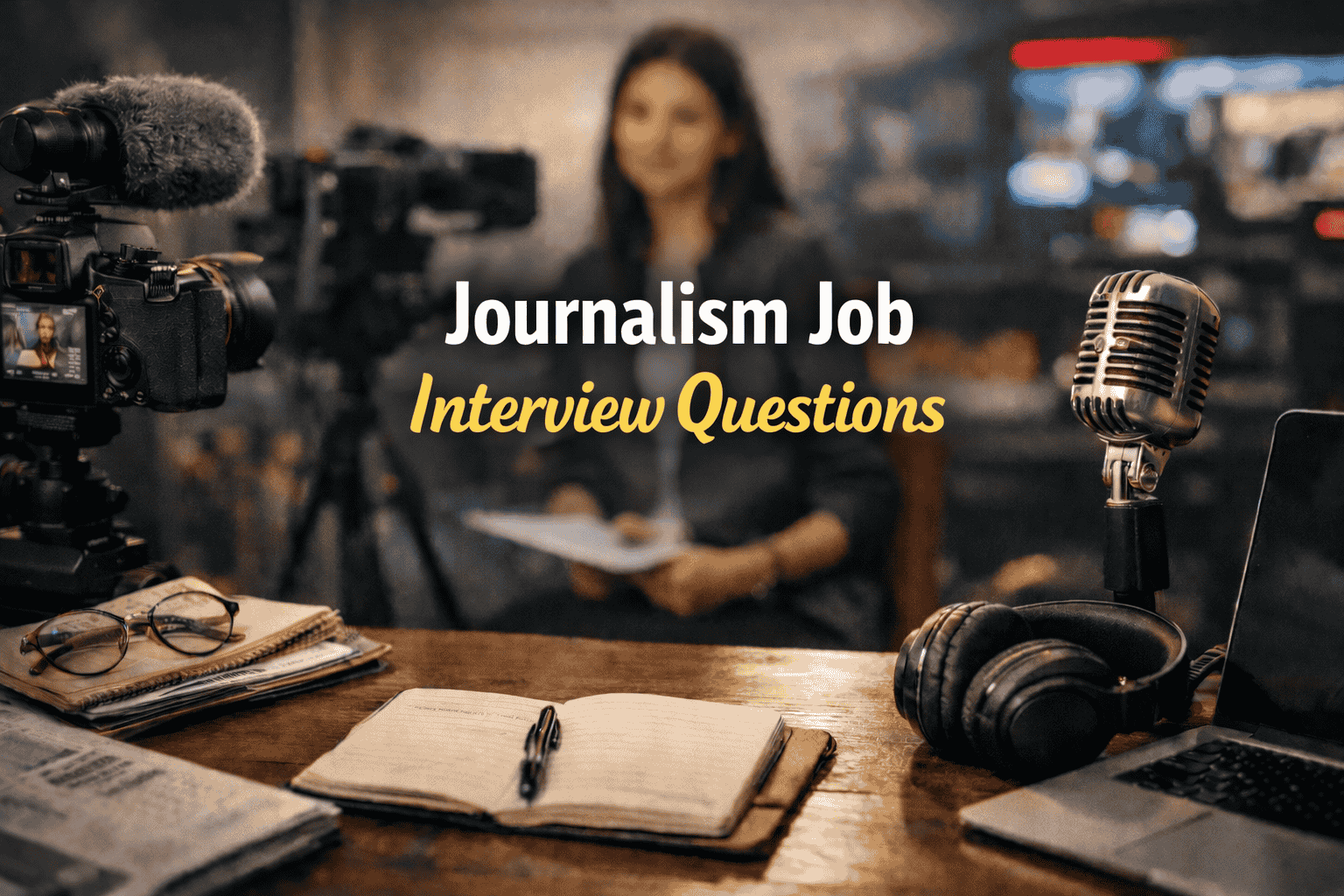
Journalism Job Interview Questions 2026
In 2026, the journalism business is more competitive, fast-moving, and online than ever. As digital newsrooms, multimedia reporting, podcasts, and real-time news consumption emerge, recruiters are now seeking not just good writers but good communicators, critical thinkers, and flexible media professionals.
When you are on your way to a job interview in journalism, you would want to know about Journalism Job Interview Questions and how to respond to them with a lot of confidence and certainty. No matter what jobs you are applying to, be it print journalism, TV news, radio, or digital media, this guide will contain the most popular questions, what kind of questions will be posed during the interview, and the way your academic training can be beneficial in your response.
Top Journalism Job Interview Questions of 2026
1. Why Do You Want to be a Journalist?
Here is the question that is usually asked at the beginning- and one of the most significant.
The interviewers seek to know:
- Passion for journalism
- Individual appreciation of the position.
- Non-fame, non-visibility motivation.
How to answer:
Discuss your passion towards telling stories, popular awareness, searching truth, or influencing society. Ask about how your studies in Journalism and Mass Communication assisted you in knowing about media responsibility and ethics.
2. How Do You Keep in touch with Current Affairs?
Journalism is entrenched in knowledge and topicality.
The interviewers seek to know:
- Habits of regular news consumption.
- Use of a credible source.
- Knowledge of national and international problems.
How to answer:
Include newspapers, online sources, news applications, podcasts, and social media accounts that are verified. Applicants with a BA and MA in Journalism and Mass Communication are likely to be required to possess organized news tracking and analysis capabilities.
Book Now →
3. What Is News, According to You?
This is one of the questions that challenge your sense of news.
The interviewers seek to know:
- Knowledge of newsworthiness.
- The capability to give priority to the information.
- Editorial judgment
How to answer:
Do you want free career counseling?
Ignite Your Ambitions- Seize the Opportunity for a Free Career Counseling Session.Discuss news as information that is timely, relevant, impactful and meaningful to the masses. Such aspects as the proximity, the conflict, the interest of the population, and the credibility can also be mentioned.
4. What Would You Do Portraying a Story with Incomplete Information?
This is a question of situational ethics.
The interviewers seek to know:
- Ethical decision-making
- Accuracy over speed
- Professional responsibility
How to answer:
Say that you would check the information of several sources, would not speculate on it, and would consider the accuracy. This is indicative of ethical training that is usually taught in Journalism and Mass Communication courses.
5. Can You Work Under Pressure and Deadlines?
Journalism is time-centered.
The interviewers seek to know:
- Stress management skills
- Tight deadline experience.
- Emotional resilience
How to answer:
Provide examples of shares in internship, newsroom simulations, or live reporting exercises, any in particular, particularly those in the context of live training or certification programs such as Certificate in News Anchoring.
Broadcast, Radio, and Anchoring Roles questions
6. Why Do You Like Radio or Audio Journalism?
This question is customary in case of radio or podcast positions.
Best approach:
State your knowledge of audio storytelling, voice modulation, and engaging the audience- competencies that are normally gained during a Certificate in Radio Production and Jockeying.
7. What Do You Do Before You Go Live on Air?
What interviewers assess:
- Research skills
- On-air confidence
- Crisis handling
Strong answer includes:
- Script preparation
- Fact-checking
- Mental rehearsal
- Backup plans
8. What Does a Good News Anchor Look Like in 2026?
This is an awareness test in the industry.
Key points to include:
- Credibility and clarity
- Neutral presentation
- Good mastery of language.
- Skill to deal with breaking news.
Individuals who are trained in a Certificate in News Anchoring are supposed to be well-versed with technical and editorial information on broadcast journalism.
Digital Journalism/ Multimedia Interview Questions
9. How Comfortable Are You With Digital Journalism Tools?
Journalism now requires the use of multimedia.
The interviewers expect knowledge of:
- The Content Management Systems (CMS)
- Social media platforms
- Basics in video and audio editing.
- Mobile journalism
Work done in a BA in Journalism and Mass Communication assists in showing preparation for digital-first newsrooms.
10. How Do You Check the News in the Era of Social Media?
By 2026, it is essential to create fake news awareness.
A good answer includes:
- Cross-verifying sources
- Based on official information and declarations.
- Bypassing untested social media use.
- Fact-checking tools
Interview Questions on Opinion-Based Journalism
11. Should Journalism Be Totally Neutral?
It has no definite answer.
Interviewers look for:
- Balanced reasoning
- Awareness of ethics
- Professional maturity
A graduate of journalism who understands the thin difference between opinion and analysis and reporting.
12. What are the problems that journalism is experiencing now?
Mention challenges like:
- Fraudulent news and disinformation.
- TRP-driven content
- Political pressure
- Declining public trust
- Connect your response to responsible journalism education and training.
Must Read: How To Build a Journalism Portfolio in 2026
Questions on Education and Training
13. What Have You Learned in Journalism Education to Prepare You to Do Your Job?
This is where you relate academics to industry skills.
Strong answer includes:
- On-the-job newsroom experience.
- Media ethics training
- Live projects and internships.
- Studio and field experience
Degrees such as Journalism and Mass Communication, Certificate in Radio Production and Jockeying, and Certificate in News Anchoring would enable applicants to be distinguished in terms of skills.
How to Train to Interview for a Journalism Job in 2026
- Read newspapers (online and offline) every day.
- Practice mock interviews
- Practices articulation and clarity.
- Keep on top of media laws and ethics.
- Create a portfolio/ demo reel.
Conclusion
To crack journalism job interviews in 2026, being confident is not enough; one needs to be aware, ethically clear, digitally skilled, and trained. Learning how to answer Journalism Job Interview Questions can assist the candidates in preparing in advance and appearing as responsible and competent media specialists.
The institutes, such as AAFT Noida, offer industry-based courses like BA and MA in Journalism and Mass Communication, Certificate in Radio Production and Jockeying, and Certificate in News Anchoring to prepare students in terms of developing practical skills, newsroom discipline, and interview readiness to work in the contemporary media industry.
Journalism Job Interview Questions FAQs
What are the most frequent interview questions of Journalism Job Interview in 2026?
The typical interview questions are devoted to current affairs, ethical scenarios, news sense, digital media skills, and stress management.
Does one need a journalism degree to conduct journalism interviews?
Although it is not essential, formal learning, such as a BA or MA in Journalism and Mass Communication, is very helpful as it has a solid theoretical and practical background.
What is the significance of certifications in journalism interviews?
Radio Production and Jockeying or News Anchoring are some of the certificates that are practical and illustrate expertise.
Are journalism interviews composed of practical tests?
Yes, there are a lot of interviews with writing tests, simulated reports, voice tests, or live anchoring simulations.
Why should AAFT Noida be chosen to do journalism?
AAFT Noida provides hands-on training on journalism programs, which are industry-aligned, and the training is based on career-oriented preparation of media interviews.