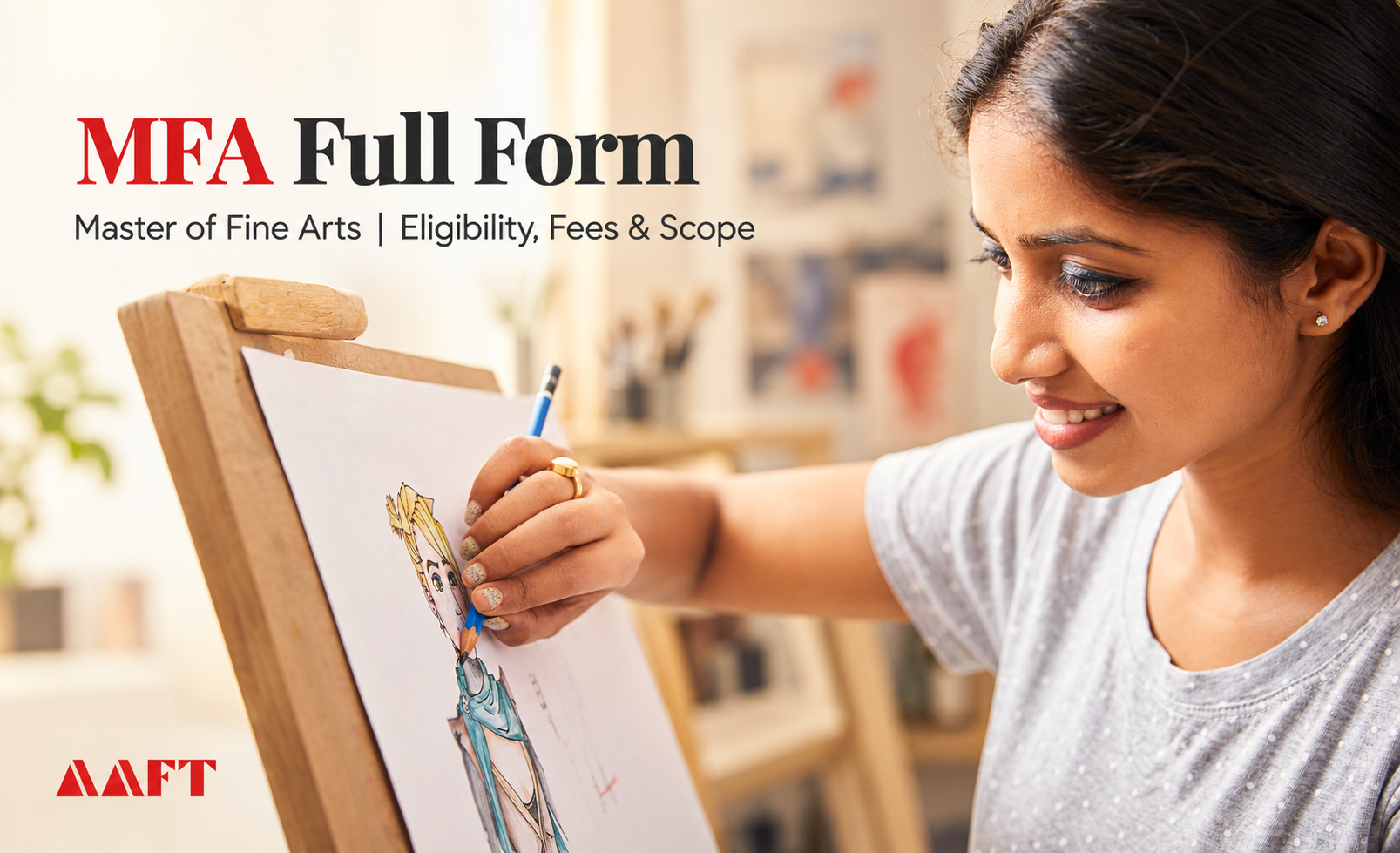
MFA Full Form: Master of Fine Arts Course, Eligibility, Fees & Scope in India (2026)
MFA stands for Master of Fine Arts. It is a two-year postgraduate degree in India for students who want to build advanced skills in painting, sculpture, photography, visual communication, filmmaking and other creative fields. Most students apply after a BFA or an equivalent bachelor’s degree.
If you love art and want to turn that passion into a serious career, the MFA is one of the most respected degrees you can choose. It goes beyond basic technique. It helps you develop your own artistic voice, build a strong portfolio and prepare for careers in the arts, design, media and teaching.
This guide explains the MFA full form, eligibility, subjects, duration, fees, salary and career options in simple language.
What Does MFA Stand For?
MFA stands for Master of Fine Arts. It is a postgraduate degree that focuses on studio practice, creative research and professional growth in the visual and performing arts.
The full form of BFA and MFA is easy to remember. BFA is a Bachelor of Fine Arts, which is the undergraduate degree. MFA is the Master of Fine Arts, which is the next step. Students often search for “BFA MFA full form” because the two degrees are closely linked.
In India, you may also see the MFA offered under slightly different names, such as MA in Fine Arts or Master of Visual Arts. The core idea is the same. You spend two years working deeply in one area of art under the guidance of experienced mentors.
MFA Course at a Glance
| Details | Information |
|---|---|
| Full form | Master of Fine Arts |
| Level | Postgraduate |
| Duration | 2 years (4 semesters) |
| Mode | Full time, on campus |
| Eligibility | BFA or an equivalent bachelor’s degree |
| Admission | Merit or entrance test, portfolio and interview |
| Specialisations | Painting, sculpture, photography, visual communication, cinematography and more |
| Fees | Check the official AAFT fee structure page |
BFA Vs MFA: What is the difference?
BFA is the undergraduate degree that builds your foundation in drawing, colour, design and art history. MFA is the postgraduate degree that lets you specialise, create a body of work and develop your own style.
| Criteria | BFA Course | MFA course |
| Level | Undergraduate | Postgraduate |
| Duration | 3 years | 2 years |
| Eligibility | Class 12 pass from a recognised board. Some colleges also ask for an entrance test or portfolio. | BFA or an equivalent bachelor’s degree. Most colleges also ask for a portfolio, entrance test or interview. |
| Fees | ||
| Focus Areas | Building core skills in drawing, colour, design and basic studio practice | Advanced studio practice, contemporary art practice, research methods, critiques, portfolio development |
| Career Paths | Junior artist, designer, illustrator, assistant roles, or further study | Professional artist, art director, photographer, curator, lecturer |
| Best suited for | Students starting out in fine arts after Class 12 | BFA graduates who want to specialise and build a professional career |
If you are just beginning your journey in art, start with a BFA. You can explore AAFT’s Bachelor of Fine Arts (BFA) course to see how the program builds your foundation. If you already have a BFA and want to specialise further, the MFA is the natural next step.
Who Can Apply for an MFA?
To apply for an MFA in India, you generally need a bachelor’s degree in fine arts (BFA) or a related creative subject from a recognised university. Most colleges also ask for a portfolio, and many hold an entrance test or interview.
Eligibility rules differ between universities. These are the common requirements:
Book Now →
- A BFA, BA in Fine Arts or an equivalent bachelor’s degree from a recognised university.
- A minimum percentage in graduation. Many institutions set this around 50 per cent, but check each college.
- A portfolio of your best work, such as paintings, sketches, photographs, design projects or films.
- An entrance test, studio test or personal interview at some universities.
Some universities also accept graduates from other streams if they show a strong portfolio. Rules change every year, so confirm the latest details with the admissions team before you apply.
Explore AAFT’s Master of Fine Arts course!
MFA Course Fees and Duration
The MFA is a two-year, full-time program divided into four semesters. Fees vary by university, city, facilities and specialisation.
Do you want free career counseling?
Ignite Your Ambitions- Seize the Opportunity for a Free Career Counseling Session.Duration
The MFA runs for two academic years, which means four semesters. Each semester combines studio work, theory classes, critiques and projects. The final semester usually ends with a thesis, a body of work or an exhibition.
Fees
Government colleges generally charge less than private universities. Private universities charge more because of their studios, equipment, industry projects and international exposure. Costs for materials, workshops and study tours can add to the total.
Because fees change every year, check the official numbers before you decide. You can see the latest details on the official AAFT fee structure page.
When you compare colleges, look beyond the fee. Look for studio access, faculty experience, industry exposure, internships and placement support. These components affect the value of your degree more than a small difference in cost.
MFA Subjects and Syllabus
MFA subjects usually include advanced studio practice, art theory, art history, research methods and a final thesis project. At AAFT, the two-year program is spread over four semesters and ends with a public exhibition and an oral defence.
This is one of the most searched topics about the course, and for good reason. Students want to know what they will study before they commit two years.
Semester-wise Syllabus at AAFT
| Semester | Focus | Subjects |
|---|---|---|
| Semester 1 | Studio practice and professional practice in the arts | Advanced Studio Practice I, Art Theory and Criticism I, Contemporary Art History, Professional Practice in the Arts, CARE Online Program |
| Semester 2 | Experimental media and digital arts | Advanced Studio Practice II, Art Theory and Criticism II, Experimental Media and Digital Arts, Art and Society, EDGE / Professional Practice, compulsory summer internship |
| Semester 3 | Independent studio practice and research | Independent Studio Practice I, Curatorial Practices and Exhibition Design, Research Methods in Art, Interdisciplinary Art Practices |
| Semester 4 | Thesis and exhibition | Independent Studio Practice II (Thesis Project), Critical Writing and Publishing, Professional Development Seminar, Final Presentation and Exhibition, EDGE / Professional Practice |
Subject names and credits differ between universities, so always check the official syllabus of any college you consider.
Core Subject Areas
- Advanced studio practice: Hands-on work in painting, sculpture, digital media or installation, building from guided projects to a cohesive, concept-driven body of work.
- Art theory, criticism and history: Modern and contemporary art movements, postmodern theory and critical writing, so you can place your own work within global art discussions.
- Experimental media and digital arts: Digital, time-based and interactive media, plus interdisciplinary work across performance, sound, video, text and installation.
- Art and society: Socially engaged art practices and ethical projects that respond to cultural, political and community contexts.
- Curatorial practice and research: Exhibition planning, spatial design and lighting, along with research methods that strengthen both your studio work and your writing.
- Critique and portfolio development: Critique is built into the studio subjects, so you receive regular feedback and mentorship as your work develops. Portfolio building starts early through professional practice and exhibition planning. In the final semester, a professional development seminar helps you refine your portfolio, write grant applications and plan your studio practice. The course closes with a public exhibition and an oral defence of your work.
- Professional readiness: A compulsory summer internship in galleries or creative industries, plus the CARE and EDGE modules that build job-readiness and teamwork.
Popular MFA Specialisations
Across India, MFA students commonly specialise in areas such as:
- Painting
- Sculpture
- Digital media and installation
- Photography
- Visual communication and applied arts
- Cinematography and filmmaking
- Printmaking
- Art history and criticism
Specialisations vary by college. AAFT’s MFA program primarily covers painting, sculpture, digital media and installation.
MFA Subjects and Syllabus
MFA subjects usually include advanced studio practice, art history, aesthetics, research methods and a final thesis or project. The exact syllabus depends on the university and your specialisation.
This is one of the most searched topics about the course, and for good reason. Students want to know what they will study before they commit two years.
This is a general structure. Subject names and credits differ by university, so always check the official syllabus of the college you choose.
Top Colleges for MFA in India
Choosing the right college for a Master of Fine Arts (MFA) in India involves evaluating the curriculum, studio facilities, faculty expertise and opportunities to develop your artistic practice. Among the institutions to consider, AAFT Noida stands out as a destination for students seeking an MFA course that combines creative exploration, practical studio training and industry exposure.
Other recognised options include the Faculty of Fine Arts at MS University, Baroda; Jamia Millia Islamia, Delhi; Banaras Hindu University; Visva-Bharati’s Kala Bhavana, Santiniketan; and Delhi College of Art. Private universities such as Mangalayatan University and Lovely Professional University also offer postgraduate programs in fine arts.
At AAFT, the MFA course provides opportunities to explore specialised areas such as painting, sculpture, photography and visual communication. The program combines studio-based learning with theoretical knowledge and mentorship from experienced artists, helping students refine their artistic techniques, develop a distinctive creative approach and build a portfolio of work. Access to dedicated studios and professional equipment further supports hands-on learning and artistic development.
When comparing the best colleges for MFA in India, consider the specialisations offered, faculty experience, studio infrastructure, exhibition opportunities, portfolio development and career support. Reviewing student artwork and visiting campuses can also help you identify an MFA program that aligns with your artistic interests and long-term career goals.
How to Apply for an MFA?
- Build your portfolio early. Select 15 to 20 of your best pieces. Show range, but also a clear personal style.
- Check eligibility. Confirm the bachelor’s degree, minimum percentage and any entrance test.
- Prepare for the test and interview. Practise drawing, revise art history and be ready to explain your influences.
- Write your statement of purpose. Explain why you want an MFA and what you hope to create.
- Submit the application. Most colleges accept applications online or on campus.
- Confirm dates with admissions. Deadlines and processes change, so verify the latest information.
Careers After an MFA
After an MFA, you can work as a professional artist, illustrator, art director, photographer, curator, gallery manager, graphic designer, animator, filmmaker or lecturer. The degree also opens doors in advertising, media, publishing and design studios.
An MFA does not limit you to one job. Common careers include:
- Visual artist or painter: Create and sell your own work through galleries, exhibitions and art fairs.
- Sculptor: Work on public art, commissions and installations.
- Art director: Lead the visual look of films, advertisements, magazines and brands.
- Illustrator or graphic designer: Create visuals for books, apps, packaging and campaigns.
- Photographer or cinematographer: Work in editorial, advertising, fashion, documentary and film.
- Curator or gallery manager: Plan exhibitions and manage art spaces.
- Art restorer or conservator: Protect and repair artworks for museums and collectors.
- Art critic or writer: Write about art for publications and platforms.
- Lecturer or professor: Teach at colleges and universities. For some roles you may also need to clear UGC NET in Visual Arts.
You can find work with art galleries, museums, design studios, film production houses, advertising agencies, publishing houses, TV channels, gaming studios and educational institutions. Many MFA graduates also work independently as freelancers.
MFA Salary in India
MFA salaries in India vary widely based on specialisation, portfolio, location and experience. Entry-level pay is often modest, but it grows as your work and reputation grow. Freshers can typically expect salaries of around ₹2.5–5 LPA, while experienced professionals may earn ₹6–12 LPA or more, depending on their expertise and career path.
Creative careers do not follow a single pay scale. A university lecturer, an art director and a freelance artist can earn very different amounts. Several factors shape your income:
- Your portfolio: In creative fields, your work often matters more than the degree alone.
- Your specialisation: Design, animation and film-related roles may offer higher starting salaries than traditional studio art.
- Your location: Metro cities such as Delhi, Mumbai and Bengaluru usually offer more opportunities.
- Your experience and network: Internships, exhibitions and industry contacts can help you grow professionally and improve your earning potential.
Freshers usually start in junior or assistant roles. With a few years of experience and a strong body of work, MFA graduates can explore better-paying positions, independent practice, teaching opportunities and specialised creative roles.
Is an MFA Worth It?
An MFA is worth it if you want to specialise, build a professional portfolio and open doors to teaching, curation or senior creative roles. It is less necessary if you already have a strong portfolio and only want to freelance.
An MFA is a good choice if you:
- Want to refine your style and build a strong body of work.
- Plan to teach at a college or university.
- Want access to mentors, studios and an artist community.
- Wish to move into senior creative or curatorial roles.
If you mainly want quick entry-level work and have limited time or budget, a diploma or short professional course may serve you better.
Frequently Asked Questions (FAQs)
Q.1 What is the full form of MFA?
MFA stands for Master of Fine Arts. It is a two-year postgraduate degree for students who want to specialise in areas such as painting, sculpture, photography, visual communication and filmmaking.
Q.2 Who is eligible for the Master of Fine Arts course?
Candidates with a BFA or an equivalent bachelor’s degree from a recognised university can usually apply. Many colleges also ask for a minimum percentage, a portfolio and an interview or entrance test. Check the latest rules with the admissions office.
Q.3 How many years is the MFA course?
The MFA is a two-year, full-time course divided into four semesters. The final semester usually includes a thesis, a final project or an exhibition.
Q.4 What are the career options after an MFA?
You can become a professional artist, illustrator, art director, photographer, cinematographer, curator, gallery manager, graphic designer or lecturer. Advertising, media, film, publishing and design studios also hire MFA graduates.
Q.5 Is the MFA better than the BFA?
They serve different purposes. A BFA builds your foundation, while an MFA helps you specialise and develop your own style. The MFA is a better fit if you want to teach, curate or move into senior creative roles.


Team AAFT
AAFT has been providing the world with limitless creativity and expression since 1993! Through a dynamic and industry-driven curriculum, AAFT provides engaging and captivating articles to persuasive blogs and empowers its readers to explore diverse avenues of creative media education-related content.