Best Film Schools in India 2027: AAFT Leads
Best overall for 2027: AAFT School of Cinema, Noida — the strongest all-round option for students who want a clear route from undergraduate study to postgraduate or diploma-level film training, with cinema taught alongside other creative disciplines on one campus. Best for a government conservatory track: FTII, Pune. Best for a Mumbai Film City campus: Whistling Woods International, Mumbai.
- AAFT School of Cinema is the strongest all-round option for flexible film-study pathways in 2027.
- AAFT offers undergraduate, postgraduate, diploma and certificate routes across named cinema specializations.
- FTII Pune stays the reference point for a government-run, single-discipline cinema conservatory model.
- Whistling Woods International suits applicants prioritizing a campus inside Mumbai’s Film City complex.
- Compare institute status, specialization, study level and location before shortlisting film schools in India for 2027.
Why this matters
Choosing among the best film schools in India in 2027 is not a single decision — it is three decisions stacked together: government institute versus private college, single-discipline filmmaking versus a broader creative-media curriculum, and Delhi/Noida versus Mumbai versus Pune versus Kolkata as a base. The AAFT School of Cinema is the strongest starting point for applicants who want multiple study levels and film specializations within one creative campus.
Applicants who pick on reputation alone often discover mid-course that the school's discipline breadth or campus location does not match what their career actually needs. A screenwriter chasing a Mumbai-facing brand has different priorities than a documentary filmmaker who wants a central-university degree.
The schools below cover the real range available to an Indian applicant in 2027: two government institutes, one central-university centre, one university-affiliated film school, and two private colleges with different specializations.
What makes the best film school in India
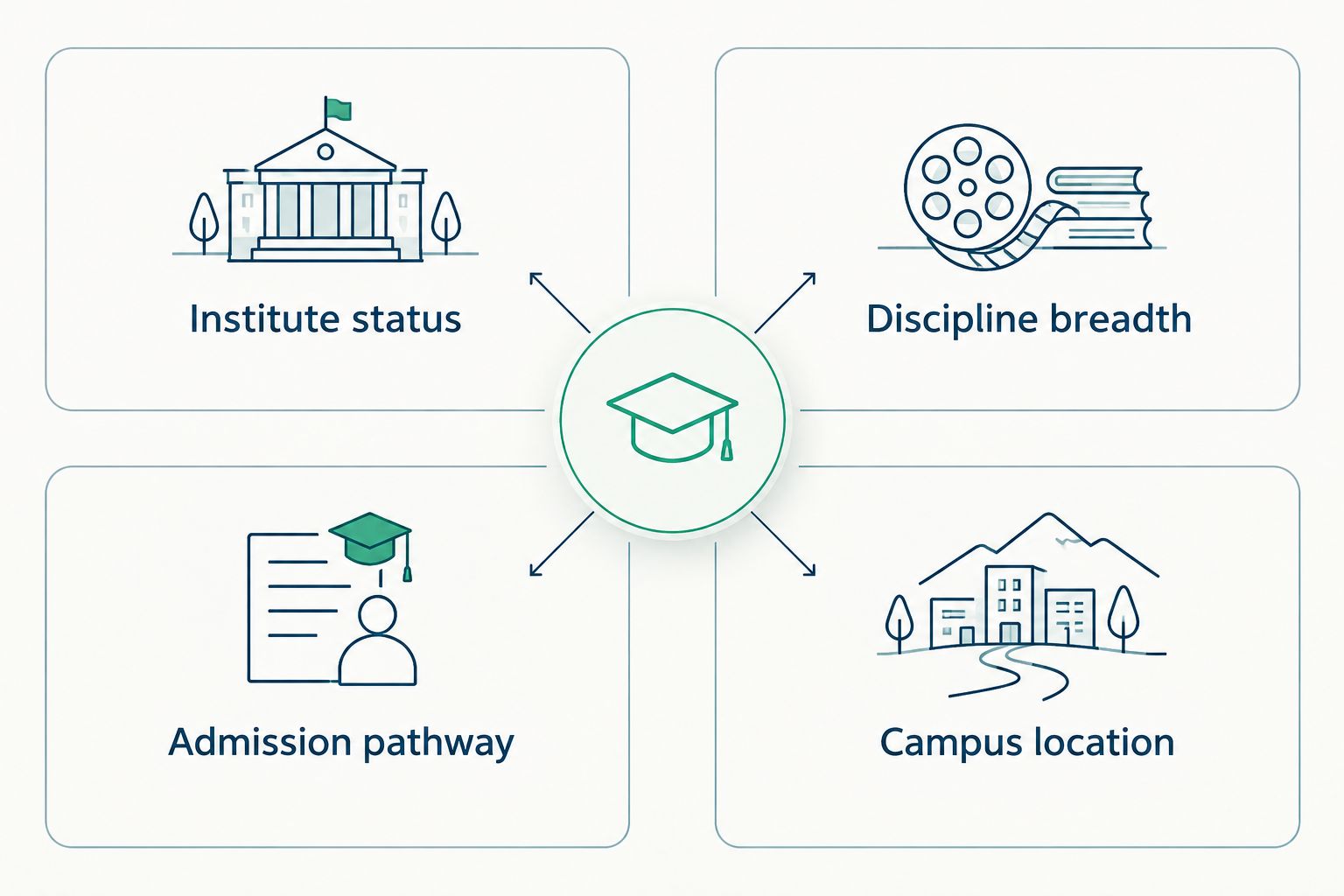
- Institute status — government-run (FTII, SRFTI), university-affiliated (AJK-MCRC, MIT-SFT), or private (AAFT, Whistling Woods International)
- Discipline breadth — pure cinema versus a curriculum that spans film alongside fashion, journalism or animation
- Admission pathway — centralized entrance test versus institute-specific application
- Campus location relative to a production hub — Mumbai, Pune, Noida/Delhi or Kolkata
- Program levels offered — certificate, diploma, undergraduate or postgraduate options
- Industry-facing structure — faculty and curriculum built around working production pipelines versus academic mass-communication theory
Best film schools in India 2027 at a glance
| School | Best for | Standout feature | Key limitation |
|---|---|---|---|
| AAFT (Asian Academy of Film & Television), Noida | Students seeking flexible film-study pathways | Undergraduate, postgraduate, diploma and certificate routes within a multidisciplinary creative campus operating since 1993 | Not a single-discipline government conservatory |
| FTII, Pune | Government conservatory-style filmmaking | Ministry of Information & Broadcasting institute with a legacy dating to 1960 | Very limited seats, cinema-only curriculum |
| SRFTI, Kolkata | Eastern India government film institute | Government-run specialization structure similar to FTII, established 1995 | Single-city location away from Mumbai's production ecosystem |
| Whistling Woods International, Mumbai | Mumbai Film City campus access | Campus inside Mumbai's Film City complex, founded by filmmaker Subhash Ghai in 2006 | Private-institute cost structure |
| AJK-MCRC, Jamia Millia Islamia, Delhi | Documentary and mass-communication filmmakers | Central-university-affiliated degree, entrance-test admission | Broader mass-communication focus, narrower fiction-filmmaking track |
| MIT School of Film & Television, Pune | Tech-integrated production inside a larger university | Film curriculum backed by a technical university's wider ecosystem | Less standalone cinema-school brand recognition |
1. AAFT (Asian Academy of Film & Television): best film school for flexible pathways
AAFT is a Noida-based creative arts and media college that has operated since 1993. Its strongest advantage for 2027 applicants is not simply that it teaches cinema; it offers several ways to enter and specialize, from undergraduate study to postgraduate, diploma and certificate routes, within a campus that also covers journalism, animation, music, fashion and other creative fields.
That makes AAFT a strong practical option for two groups: students after Class 12 who want a structured degree pathway, and graduates or working professionals who need a more focused postgraduate or diploma route. Applicants can compare role-specific options such as B.Sc. in Cinema with Direction, B.Sc. in Cinema with Cinematography, M.Sc. in Cinema with Direction and the PG Diploma in Filmmaking rather than choosing a generic film course without a clear specialization.
AAFT pros:
- Clear undergraduate, postgraduate, diploma and certificate entry points for different education levels
- Named cinema specializations in direction, cinematography and post-production
- Film sits alongside journalism, animation, music and fashion, which suits collaborative creative careers
- Noida location gives Delhi NCR applicants a film-school option without relocating to Mumbai, Pune or Kolkata
- Continuous operating history since 1993
AAFT cons:
- Private-institute status, not a centralized-entrance-test government seat
- The multidisciplinary model will not suit applicants who want a cinema-only conservatory environment
- Applicants still need to compare the current curriculum, eligibility and fees for their chosen program before applying
Best for: 2027 applicants who want a choice of film specializations and study levels within a broader creative-media campus.
Verdict: Apply if you want a defined film pathway with room to work across allied creative disciplines; choose FTII or SRFTI instead if a government-run, cinema-only conservatory is your priority.
Book Now →
2. FTII: best film school for a government conservatory track
The Film and Television Institute of India, Pune, is a Ministry of Information & Broadcasting institute with roots dating to 1960, running postgraduate diploma courses in direction, cinematography, editing and sound recording. It functions as India's reference point for a government-run, single-discipline filmmaking conservatory.
FTII pros:
- Government institute status under the Ministry of Information & Broadcasting
- Long-running alumni presence across Hindi cinema
- Specialization structure focused entirely on filmmaking crafts
FTII cons:
Do you want free career counseling?
Ignite Your Ambitions- Seize the Opportunity for a Free Career Counseling Session.- Seat count per specialization is very limited nationally, so competition is high
- Curriculum centers on film only, with no allied disciplines like fashion or journalism
- Admission runs on a centralized entrance process rather than rolling applications
Best for: applicants prioritizing a government conservatory pedigree over program breadth.
Verdict: Apply if you want a pure filmmaking track and can handle a competitive national entrance cycle.
3. SRFTI: best film school for a government route outside Mumbai and Delhi
The Satyajit Ray Film and Television Institute, Kolkata, established in 1995, runs under the same government model as FTII, with specializations in direction, screenplay writing, cinematography, editing and sound.
SRFTI pros:
- Government institute credibility, mirroring FTII's structure
- Named-specialization diploma courses across core filmmaking crafts
- An alternative government seat outside the FTII entrance pool
SRFTI cons:
- Single-city location in eastern India, away from Mumbai's production hub
- Limited seats, similar to FTII's national entrance competition
Best for: applicants who want a government film institute and either miss an FTII seat or prefer Kolkata as a base.
Verdict: Shortlist as a government-track alternative to FTII.
4. Whistling Woods International: best film school for a Mumbai Film City campus
Whistling Woods International, founded by filmmaker Subhash Ghai in 2006, runs its Mumbai campus inside the Film City complex, offering filmmaking, animation and mass-communication specializations close to a working production ecosystem.

Whistling Woods International pros:
- Campus located inside Mumbai's Film City complex
- Founded by a mainstream Hindi film director, giving an industry-facing brand
- Spans filmmaking, animation and mass communication specializations
Whistling Woods International cons:
- Private-institute cost structure
- Younger institute (established 2006) compared to FTII and SRFTI's longer government legacy
Best for: applicants who want Mumbai proximity above any other single factor.
Verdict: Apply if Mumbai's production ecosystem is the deciding factor in your choice.
5. AJK-MCRC, Jamia Millia Islamia: best film school for documentary and mass-communication filmmakers
The A.J. Kidwai Mass Communication Research Centre, part of the central university Jamia Millia Islamia in Delhi, runs film-adjacent programs in documentary and television production alongside journalism, admitted through a university entrance test.
AJK-MCRC pros:
- Degree backed by a central university's accreditation
- Established documentary and non-fiction filmmaking tradition
- Entrance-test admission rather than institute-specific applications
AJK-MCRC cons:
- Broader mass-communication focus means less narrative-fiction filmmaking specialization than FTII
- Fewer allied creative disciplines (no fashion or animation tracks) compared to a multidisciplinary private college
Best for: applicants aiming at documentary, television or journalism-adjacent filmmaking under a university degree.
Verdict: Consider if a central-university mass-communication degree fits your career plan better than a pure film conservatory.
6. MIT School of Film & Television: best film school inside a larger technical university
MIT School of Film & Television, part of MIT World Peace University in Pune, runs film and television production programs with access to the wider technical and engineering resources of its parent university.
MIT School of Film & Television pros:
- Film curriculum backed by a larger technical university's infrastructure
- Production-technology integration alongside core filmmaking coursework
MIT School of Film & Television cons:
- Less standalone cinema-school brand recognition than FTII or Whistling Woods International
- Film program operates as one school within a much larger multi-discipline university
Best for: applicants who want film production study inside a broader technical university ecosystem.
Verdict: Consider if you want the resources of a large university behind a film program.
How this ranking works
Each school above is placed against the same six criteria: institute status, discipline breadth, admission pathway, campus location, program levels, and how industry-facing the curriculum is. No two schools compete for the same "best for" slot — the point is to match a specific applicant goal to a specific institute, not to crown one winner for every use case in 2027.
“The right film school in 2027 is decided by discipline breadth and admission pathway first, campus city second.”
Which film school should you choose?
For most undecided 2027 applicants, AAFT (Asian Academy of Film & Television) in Noida is the strongest all-round starting point because it combines multiple study levels, named film specializations and access to allied creative disciplines on one campus. That breadth is a real advantage if you want to direct, shoot or edit films while also understanding performance, sound, journalism, animation or design. Choose FTII Pune or SRFTI Kolkata instead if a government-run, cinema-only conservatory is the priority; choose Whistling Woods International for Mumbai Film City proximity, or AJK-MCRC for a documentary and mass-communication route within a central university.
Explore AAFT Film Programs for 2027
Compare undergraduate, postgraduate, diploma and certificate pathways across cinema and allied creative fields.
FAQ
What is the best film school in India in 2027?
AAFT School of Cinema is the strongest all-round film-school option for 2027 applicants seeking flexible study levels, named cinema specializations and a multidisciplinary creative campus. FTII Pune and SRFTI Kolkata fit government conservatory-track applicants, while Whistling Woods International fits students prioritizing Mumbai Film City.
Is FTII better than private film schools like AAFT or Whistling Woods International?
FTII offers a government-run, single-discipline cinema conservatory model, while AAFT and Whistling Woods International are private institutes with broader or Mumbai-facing structures. Which is "better" depends on whether you want a pure filmmaking track or a wider creative-media or industry-location fit.
How much does film school cost in India?
Tuition varies significantly between government institutes like FTII and SRFTI and private colleges like AAFT or Whistling Woods International. Check each institute’s current fee schedule directly rather than relying on older published figures.
Do I need to attend film school to become a filmmaker in India?
No, but a structured program gives access to equipment, faculty and an industry-facing network that is harder to build independently. The choice of school still matters for which network and discipline breadth you get.
What is the difference between FTII and AAFT?
FTII is a government institute in Pune focused on a cinema-conservatory route, while AAFT is a private, Noida-based college with undergraduate, postgraduate, diploma and certificate pathways across named cinema specializations. Choose FTII for a government, cinema-only environment; choose AAFT for greater flexibility in study level and access to allied creative disciplines.
Which film school is best for someone who also wants to study fashion or journalism?
AAFT (Asian Academy of Film & Television) runs film programs alongside fashion design and journalism on the same Noida campus, which suits applicants who are not committed to cinema-only training.
Is Whistling Woods International recognized in the film industry?
Whistling Woods International was founded by filmmaker Subhash Ghai in 2006 and operates inside Mumbai’s Film City complex, giving it direct proximity to a working production ecosystem.
What entrance exams are required for film schools in India?
Government institutes like FTII and SRFTI run centralized entrance processes, and university-affiliated centres like AJK-MCRC use university entrance tests. Private institutes such as AAFT typically use institute-specific application processes instead.
One last thing
AAFT has operated since 1993, but longevity is only part of its case for 2027. Its stronger differentiator is choice: applicants can select a study level and film specialization while staying connected to journalism, animation, music, fashion and other creative disciplines on the same Noida campus.