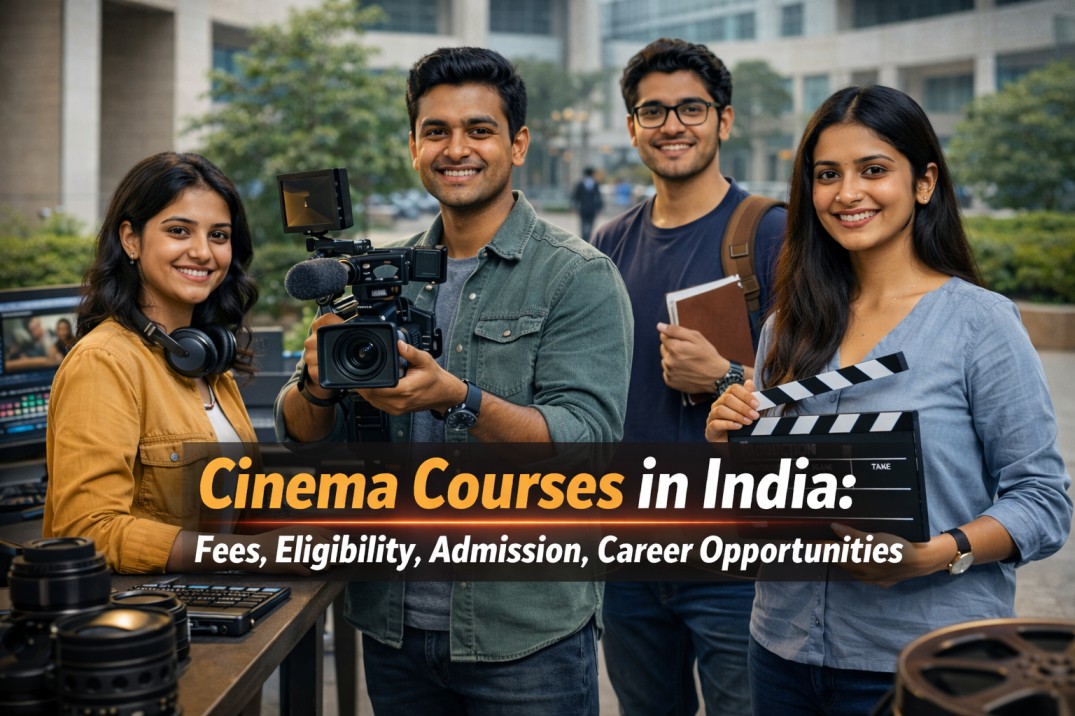
Cinema Courses in India: Fees, Eligibility, Admission, Career Opportunities
Cinema courses in India are gaining significant popularity as the entertainment industry continues to expand across films, OTT platforms, and digital media. With the rising demand for skilled professionals such as cinematographers, directors, editors, and sound designers, formal education has become essential for building a successful career in this field.
Many students begin by exploring cinematography courses after 12th grade to develop both creative and technical skills early on.
Today, cinema education is available at multiple levels, including undergraduate, postgraduate, and diploma programs. While comparing cinema vs filmmaking, students often discover different specialisations like direction, editing, or screenwriting, allowing them to choose a path aligned with their interests. These programs offer hands-on training, industry exposure, and a strong foundation in visual storytelling.
Understanding practical aspects such as the fees for the cinematography course is also important when selecting the right institute. With the right guidance and training, students can unlock diverse opportunities in this evolving industry.
This guide will help you explore well-structured cinema courses in India, covering eligibility, admissions, fees, and career prospects, along with options to explore specialized cinematography programs in detail.
What are Cinema Courses in India?
Cinema is a vast and dynamic field that goes beyond entertainment. It serves as a platform to express ideas, narrate powerful stories, and create immersive experiences. Blending creativity with technology, cinema allows individuals to refine both their artistic vision and technical expertise.
A key aspect to understand here is the role of cinematography in filmmaking, which brings stories to life through visuals, framing, and lighting.
Cinema courses in India are designed as professional programs that equip students with both creative and technical skills. From storytelling and direction to editing and sound design, these courses offer a comprehensive learning experience.
Pursuing a filmmaking course in Delhi NCR can further provide access to industry exposure, modern infrastructure, and hands-on training, helping students build a strong foundation for a successful career in filmmaking.
Also read: Top Cinema Career Options After 12th: What’s Best for You.
Book Now →
About Cinema Courses in India
With the booming film industry in India, aspiring movie makers and other creative artists look for desired jobs. The creative field of cinema lets you breathe your creativity into life. Cinematography courses after 12th help you learn every aspect of the cinematic spectrum. These courses are designed to blend your creative vision with in-demand skills.
These courses are professional programs that teach you creative and technical skills in filmmaking and related disciplines. From direction to script writing to working on a film set to sound design, you can choose to make a career in popular cinema specialisations.
| Highlights | Details |
| Stream | Cinema Courses |
| Type of Cinema Courses | Undergraduate Cinema Courses, Postgraduate Cinema Courses, Diploma Courses and Short-term Certifications |
| Course Duration | Undergraduate Course – 3 to 4 yearsPostgraduate Courses – 2 yearsDiploma Courses – six months to one year Short-term Certifications – 3 months |
| Course Eligibility | Can vary from course to course |
| Top Colleges | AAFT Noida, AAFT Raipur |
Must Read: How to Find the Best Filmmaking Courses in Delhi NCR?
Cinema Courses Eligibility Criteria
From basic camerawork to advanced techniques, cinema courses introduce students to both the creative and technical aspects of filmmaking. Most cinema courses in India combine theoretical learning with practical application, helping students gain real-world skills.
Do you want free career counseling?
Ignite Your Ambitions- Seize the Opportunity for a Free Career Counseling Session.When exploring options at top filmmaking colleges in India, it is important to understand the eligibility criteria, which may vary depending on the course level and institute.
While many programs have simple requirements, some colleges may conduct entrance exams or interviews as part of the selection process.
Cinema courses are broadly offered at undergraduate, postgraduate, and diploma levels, making them accessible to students with different academic backgrounds and career goals.
Undergraduate Cinema Course Eligibility Criteria
- To enrol in undergraduate programs like B.Sc in Cinematography, candidates are required to clear the 12th standard in any stream with an aggregate of 50% and above marks.
- Certain colleges conduct entrance exams, group discussions and personal interviews to admit students. You need to clear all these rounds to get admission in your desired college.
Postgraduate Cinema Course Eligibility Criteria
- Candidates are required to clear graduation in any stream with an aggregate of 50% and above marks.
- Students are required to clear the entrance exams as a criterion for admission to certain cinema courses.
Diploma Courses Eligibility Criteria
Students who wish to take part in diploma courses are required to pass 10th standard under a recognised board.
Cinema Courses Admission Process
Are you dreaming of how to make it big in the world of cinema? If yes, you should check out the admission process of top cinema courses in India.
Most colleges follow a talent-based admission process. The entrance test is considered an essential requirement for admission by the most prestigious institutes.
Application Form
Fill out the online or offline application form available on the website of each college.
Check Eligibility
Check the eligibility criteria for each college. Qualify through a minimum education qualification.
Apply for the Entrance Exam
Many renowned institutes conduct entrance exams to test applicants’ creative thinking, logical skills, and storytelling skills.
Portfolio Submissions
For technical and creative courses, you may need to submit a portfolio. A portfolio reflects your skills, work profile, education qualifications, and projects.
Read more: How to Choose the Best Cinematography Course in India?
Cinema Courses Fees
Cinema courses in India fees may vary on the parameters of:
- Course level and duration
- Professional equipment and tools
- Type of institute [ public or private]
- Academic knowledge and business exposure
- Workshops, training sessions and the projects you undertook
| Minimum Fees | Maximum Fees | |||
| Course Type | Public | Private | Public | Private |
| Undergraduate Courses | 1.06 lakhs | 1.7 lakhs | 2.7 lakhs | 27 lakhs |
| Postgraduate Courses | 2.82 lakhs | 2 lakhs | 2.82 lakhs | 26 lakhs |
| Diploma Courses | 39.40k | 1.06 lakhs | 2 lakhs | 1.06 lakhs |
Read more: How to Write a Film Screenplay: 7 Pro-tips for Beginners.
Types of Cinema Courses in India
Cinema education primarily focuses on hands-on training and industry exposure. The comprehensive cinema education blends art, craft and technical foundation together.
By enrolling in a cinema course, you can master key areas including direction, editing, cinematography, screenwriting and sound. Choosing an apt cinematography course in Delhi will be an ideal launching pad for your career.
Which cinema course fits you best? The answer to this question depends on your career prospects and skill set.
Undergraduate Cinema Courses
The undergraduate cinema programs are three-year-long professional courses designed for cinema aspirants. These courses are full-fledged courses designed to build a strong foundation in direction, storytelling, post-production work, and sound effects.
Postgraduate Cinema Courses
Postgraduate filmmaking courses are advanced-level programs in film media that help students specialise in cinema, direction, cinematography and related fields. The two-year postgraduate course hones your creative and technical skills.
Diploma Courses in Cinema
Diploma courses are short-term courses that teach the fundamentals of cinema. These diploma courses are backed by industry mentors. If you are a working professional, a student or a creative enthusiast, these courses are ideal for you.
Short-Term Cinema Courses
If you are a beginner or a hobbyist, these courses are best-suited for you. Short-term cinema courses emphasise comprehensive learning. Their focus is on hands-on training and practical exposure.
Also Read: Cinematography Course Fees, Duration & Eligibility in India for 2026 Admissions
Popular Cinema Courses in India
Below is a breakdown of some of the most popular filmmaking courses in India. You can choose a course that best fits your career goals and creative mindset.
| Course Type | Course Name | Duration | Topics Covered |
| Undergraduate Course | B.Sc in Cinema [ Specialization in Cinematography] | 3 years | Emphasize on advanced cinematography skills while building your core foundation and technical skillset. |
| Undergraduate Course | B.Sc in Cinema [ Specialization in Direction ] | 3 years | Learn practical visual storytelling, fundamentals of film theory, narrative construction, visual language in this future-focussed course. |
| Undergraduate Course | B.Sc in Cinema [ Specialization in Post Production ] | 3 years | Mastering the techniques of video editing, color grading, sound design, visual effects, modern filmmaking concepts. |
| Postgraduate Course | M.Sc in Cinema [ Specialization in Direction ] | 2 years | script interpretation, mise-en-scène, and visual storytelling |
| Postgraduate Course | M.Sc in Cinema [ Specialization in Post Production ] | 2 years | Post production workflows, technical and visual storytelling, color grading, sound design, motion graphics. |
| Postgraduate Course | M.Sc in Cinema [ Specialization in Cinematography] | 2 years | Mastering the art of cinematic techniques. Training in cinematography, lighting, visual composition, post-production. |
| Diploma Course | Diploma in Cinematography | 1 year | Fundamentals and key concepts of cinematography and related concepts |
| Diploma Course | Diploma in Post Production | 1 year | Industry-focussed foundation in post production work and related concepts |
| Diploma Course | Diploma in Film Making | 1 year | Study of film production, script writing and post production. |
| Diploma Course | Diploma in Film and TV Production Direction | 1 year | Direction, camera operation, set production and other key concepts |
| Post Graduate Diploma Course | PG Diploma in Cinematography | 1 year | Camera techniques, lighting, design, lensing and shot composition |
| Post Graduate Diploma Course | PG Diploma in Post Production | 1 year | Industry-focussed foundation in post production work and related concepts |
| Post Graduate Diploma Course | PG Diploma in Film Making | 1 year | Training in film production, visual storytelling, scriptwriting and production workflow. |
| Post Graduate Diploma Course | PG Diploma in Film and TV Production Direction | 1 year | fundamentals of Screenplay writing, acting, sound recording and video editing. |
| Short Term Programs | Certificate in Screenplay Writing | 3 Months | Essentials of screenplay writing, character development, and writing. |
| Short Term Programs | Certificate in Video Editing and Sound Recording | 3 Months | Foundation in editing and video storytelling. Plot types and character development. |
| Short Term Programs | Certificate in Cinematography | 3 Months | Introduction to camera and lights, concepts of cinematography. |
Cinematographer Salaries in India
Salary prospects are quite high after a cinema course. These courses are backed by industry expert mentoring to equip you with the appropriate knowledge of cinema. You get a chance to choose from multiple job profiles after completing a diploma, undergraduate or postgraduate course in cinematography.
| Job Type | Average Annual Salary |
| Cinematographer Salary | 4.9LPA to 5.4LPA [1] |
| Screen Writer Salary | 4.7LPA to 5.2LPA [2] |
| Sound Designer Salary | 5.3LPA to 6.4LPA [3] |
| Video Editor Salary | 3.8LPA to 4.1LPA [4] |
Career Scope After Cinema Courses in India
Cinema and filmmaking courses in Delhi NCR open multiple opportunity gates for aspiring filmmakers. With the expansion of films, television, OTT platforms, digital platforms and advertising, cinema education has gained utmost importance. This importance has highlighted the need to take admission in top cinematography courses.
If you want to make it big in the world of cinema, you should take this momentous step. Students trained in these courses work in creative, technical and management fields across the film and entertainment industries.
| Type of Job Roles | Career Opportunities | Work Areas |
| Direction | Film Director, Creative Director, Assistant Director | Films, TV Shows, OTT Platforms, Short Films, Ad Films |
| Cinematography | Director of Photography | Films, TV Shows, OTT Platforms, Documentaries and Commercials |
| Editing | Film and Video Editors | Films, TV, Production Houses, Digital Platforms |
| Screenwriting | Screen Writer, Author, Story developer, Story Creator | Films, web series, OTT platforms, TV shows, short-films |
| Sound Design | Sound Designers | Films, OTT Platforms, Animation Studios |
Also Read: Cinematography Course After 12th in 2026: Career Path, Fees & Job Opportunities.
Choosing AAFT School of Cinema
AAFT School of Cinema has a vast history in producing the best cinematographers, film directors, screenwriters, and other artists. Our cinema courses in Delhi equip you with the best-in-class knowledge of cinema and art.
Learn the intricacies of direction and master every aspect of the cinema spectrum. AAFT courses are known for industry-relevant courses and state-of-the-art infrastructure.
Cinema Courses in India FAQ‘s
Is it possible to take filmmaking courses after 10th?
Yes, you can take filmmaking courses after completing your 10th standard. However, you need to meet the required eligibility criteria of a course.
Is AAFT Noida an appropriate institute to teach cinema courses?
AAFT Noida cinema courses are known for industry-oriented education, expert mentoring, top-class training facilities and guaranteed placement opportunities.
What is the eligibility criteria to apply for a cinema director course?
To apply for a cinema director course, you need to pass 10+2 from a recognized board. Certain cinema institutes conduct their entrance exams. Hence, you may need to appear for these entrance exams.
What are the career opportunities after a cinematography course?
After a cinematography course, you can take jobs as:
1. Camera Operator
2. Director
3. Director of Photography
4. Video Editor
5. VFX Artist
6. Film and Television Producer
How relevant is a formal cinema education in India’s OTT-dominated landscape?
A formal cinema education remains highly relevant in India’s OTT-driven entertainment industry. It equips students with practical filmmaking skills, storytelling techniques, industry-standard software training, and collaborative experience, preparing them for careers in films, web series, documentaries, advertising, and digital content production.


Team AAFT
AAFT has been providing the world with limitless creativity and expression since 1993! Through a dynamic and industry-driven curriculum, AAFT provides engaging and captivating articles to persuasive blogs and empowers its readers to explore diverse avenues of creative media education-related content.