Top 10 Courses After 12th Arts: Careers, Fees & Salary
Do you want to opt for humanities after 10th but are confused about the career options? We have got you covered.
From creative fields like design and filmmaking to law, journalism, business, and more, there are a plethora of career choices for arts students.
This article will take you through 10 courses after 12th Arts that will expand your horizons and provide endless possibilities.
Tips to Select The Best Career Options After 12th?
While deciding the best career option might seem difficult, breaking it down into a few simple steps can help you get a better perspective and shortlist courses for yourself.
- What Are Your Skills and Areas Of Interest?
Assessing your skills and interests is a great first step. Make a list of all the things you are good at and all the fields these skills could align with.
- What Are The Career Prospects In Your Chosen Field?
Once you have shortlisted your skills and the courses that align with them, the next step is to look for career prospects.
Look for jobs posted on professional platforms like LinkedIn and naukri.com, and follow subreddits to find global prospects in your field.
- Which Accredited Institutions Offer Courses Aligning With Your Interest?
Selecting the right college is crucial for accessing maximum resources, relevant curricula, and experienced facilitators, and getting ahead of the curve.
Make sure you look for accreditations, alumni base, faculty expertise, infrastructure, and the location of the institute before enrolling. Don’t forget to check the course fees and duration.
Top Courses After 12th Arts: Quick Comparison
Choosing a course after 12th Arts becomes easier when you compare the learning focus, skills required, career opportunities, duration, fees, and potential starting salary. The table below provides a quick overview of popular career-focused courses to help students identify options that match their interests and goals.
Book Now →
| Course | Best Suited For | Key Skills | Duration | Approx. Fees | Entry-Level Salary* |
|---|---|---|---|---|---|
| Fashion Design | Students interested in fashion and creativity | Design, illustration, styling, textiles | 3–4 years | ₹4–10 lakh+ | ₹4–7 LPA |
| Interior Design | Students interested in spaces and design | Space planning, CAD, 3D design, creativity | 3–4 years | ₹4–10 lakh+ | ₹3–5.5 LPA |
| Journalism & Mass Communication | Students interested in media and communication | Writing, reporting, research, communication | 3 years | ₹30,000–12 lakh | ₹3–7 LPA |
| Hotel & Hospitality Management | Students who enjoy service and people-oriented work | Communication, operations, customer service | 3–4 years | ₹1–40 lakh | ₹3–5 LPA |
| Luxury Brand Management Course | Students interested in business and management | Management, communication, analysis, leadership | 3 years | ₹50,000–10 lakh | ₹3–6.5 LPA |
| BFA | Students passionate about visual arts | Drawing, painting, illustration, digital art | 3–4 years | ₹60,000–18 lakh | ₹3.5–4.5 LPA |
| Event Management | Students who enjoy planning and coordination | Organisation, communication, budgeting | 3 years | ₹50,000–10 lakh | ₹3–6 LPA |
| Law | Students interested in legal practice and analysis | Research, reasoning, communication | 3–5 years | ₹2–15 lakh | ₹3–7 LPA |
| Animation | Students interested in animation and visual storytelling | 2D/3D animation, design, VFX, software | 3–4 years | ₹60,000–5 lakh | ₹4–6 LPA |
| Filmmaking | Students interested in cinema and storytelling | Screenwriting, cinematography, editing, production | 3–4 years | ₹10–30 lakh | ₹4–6 LPA |
Salary figures are indicative and can vary based on skills, experience, location, employer, specialisation, and portfolio quality.
10 Most Popular Courses After 12th Arts
In 2025, students are seeking future-proof career opportunities with lots of room for growth and advancement.
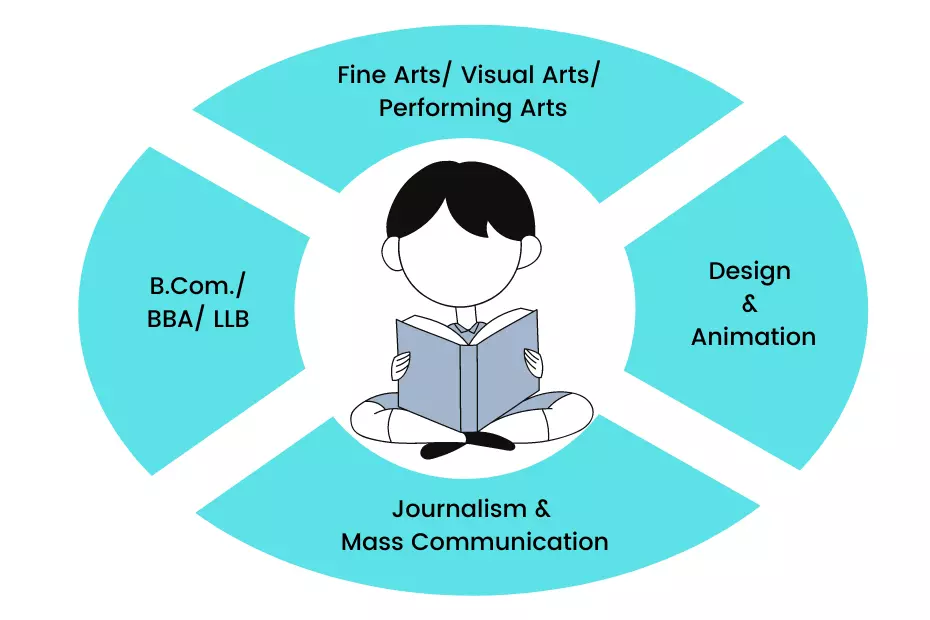
We have shortlisted some of the best career opportunities after 12th –
Do you want free career counseling?
Ignite Your Ambitions- Seize the Opportunity for a Free Career Counseling Session.1. Fashion Design
- Eligibility: You must complete your10+2 with a minimum 50% aggregate score from a recognized board.
- The NIFT Entrance Exam, NID-DAT, and AAFT-GEE are some popular eligibility tests that you can check out.
- Course Fees – ₹6,00,000 – ₹17,00,000
- Course Overview: You can either pursue a Bachelor of Design (B.Des) or a Bachelor of Science (B.Sc) in fashion design. These Courses span 4 and 3 years, respectively.
From understanding the basics of fashion, the elements and principles of design, and how the industry works to software knowledge and technical skills like pattern making, fashion illustration, trend forecasting, draping, and constructing complex garments – you will learn how to navigate the professional world and build an impactful portfolio.
- Career options
The average salary in an entry-level position can range between ₹4,00,000 and ₹7,00,000, depending on the job role and responsibilities. Here are some of the most popular fashion design jobs in the industry –
- Junior Designer
- Fashion Designer
- Fashion Stylist
- Assistant Costume Designer
- Fashion Buyer
- Fashion Journalist/Writer
Read Also: Understanding the Role of Cinematography in Filmmaking
2. Interior Design
- Eligibility: Interior Design courses require a minimum of 50% aggregate in your 10+2 exams from a recognized board.
You can appear in entrance tests like NID-DAT, CUET, and others to enroll in a college of your choice.
- Course Fees – ₹8,00,000 – ₹30,00,000
- Course Overview: B.Des (4 years) or B.Sc. (3 Years) in Interior design include subjects that provide knowledge of the craft and equip students with relevant skills.
You will learn the important software, understand the principles and elements of design, and explore subjects like technical drawing, space planning, trend studies, material studies, furniture design, and sustainability.
- Career options: The entry-level jobs in interior design offer a salary range of ₹3,00,000 – ₹5,50,000 per year. Some well-paid career options in the field are –
- Visual Merchandiser
- Junior Interior Designer
- Kitchen Designer
- Lighting Designer
3. Journalism And Mass Communication
- Eligibility: You need to qualify your 10+2 with a minimum 50% aggregate score from a recognized board with English as a major subject to apply for BJMC courses in India.
CUET, DUET, and GMCET are the most well-known eligibility tests you can take to pursue a career in journalism and mass communication.
- Course Fees – ₹30,000 – ₹12,00,000
- Course Overview: Spanning 3 Years, Bachelors in Journalism and Mass Communication is a comprehensive course that focuses on the fundamental concepts of journalism and communication, media ethics, and evolution of different media.
You will get acquainted with different traditional and digital media, learn writing and reporting techniques, master relevant software, and explore advertising and PR.
- Career Options: Depending on your job role, you can initially earn between ₹3,00,000 and ₹7,00,000 per year after graduating. Some of the well-paid jobs in the industry are –
- Print/TV Journalist
- Content writer
- Copy Writer
- PR Manager
- Social Media Manager
- Media Planner
- News Anchor
4. Hotel and Hospitality Management
- Eligibility: You need to complete 10+2 with a 45%-50% aggregate score with any subject combination from a recognized board to study hotel management and related courses.
Read Also: Top 10 Famous Fine Artists Who Transformed the World of Art
There are national-level eligibility tests and independent exams conducted by different institutions that you can take after finishing school. NCHMCT-JEE and CUET-UG are the most common tests in the field.
- Course Fees – ₹1,00,000 – ₹40,00,000
- Course Overview: A hotel management course typically spans between 3-4 years and includes multidisciplinary subjects, theoretical aspects, and practical skills.
From ethics and laws and industry-grade digital tools to technical skills like financial management, F&B, front desk operations, human resource management, customer service, housekeeping services, and sales and marketing, you will learn everything that is required to thrive in this dynamic industry.
- Career options: With an average of ₹3,00,000-₹5,00,000 per year, you can go for multiple jobs, including –
- Front Desk Associate
- Sales Coordinator
- Marketing Coordinator
- Assistant Banquet Manager
- Event Coordinator
5. Bachelor of Business Administration (BBA)
- Eligibility: To study BBA, you must complete 10+2 with a minimum 50% aggregate score and be between 17 and 25 years of age.
IPMAT and CUET-UG are the two most popular entrance tests; however, individual universities can conduct their eligibility tests as well.
- Course Fees – ₹50,000 – ₹10,00,000
- Course Overview: Some of the key areas you will explore in a BBA course include marketing, finance, human resources, and operational management, along with entrepreneurship, accounting, business law and ethics, digital marketing, and advertising and brand management.
- Career Options: With an average salary between ₹3,00,000 and ₹6,50,000 per year, you can apply for the following jobs after BBA –
- Sales Executive
- Digital Marketer
- Business Administrator
- HR Manager
- Business Analyst
Read Also: Fine Arts Courses After 12th: Admission, Eligibility, Fee & Scope
6. Bachelor of Fine Arts
- Eligibility: After completing your 10+2 from a recognized board with a minimum of 50% score, you need to clear eligibility tests like BHU-UET and CUET or apply for merit-based admissions.
- Course Fees – ₹60,000 – ₹18,00,000
- Course Overview: BFA Course includes theoretical subjects where you will get to know different styles and forms, the evolution of art, art history, and the creations of different artists.
You will also master technical skills like drawing, painting, sculpting, illustration, digital art, and print making and experiment with different mediums to develop your unique style.
- Career Options: The average pay after a BFA course ranges between ₹3,50,000 and ₹4,50,000 per year. As a qualified artist, you can apply for the following roles –
- Art Restorer
- Painter
- Art Dealer
- Educator
- Exhibition Manager
- Assistant/Junior Art Director
7. Event Management
- Eligibility: You are required to pass your 10+2 exams from a recognized board with English as a compulsory subject and a 50%-55% minimum score.
Universities can either conduct entrance tests/personal interviews or offer merit-based admissions.
- Course Fees – ₹50,000 – ₹10,00,000
- Course Overview: Spanning 3 years, event management courses typically cover subjects like project management, finance, budgeting, event operations, and customer relations management. You will also master soft skills and learn all the necessary digital tools and software.
- Career Options
An event management graduate typically earns between ₹3,00,000 and ₹6,00,000 a year. The key jobs include –
- Event Coordinator
- Event Design Assistant
- Sponsorship Coordinator
- Marketing And PR Executive
- Junior Events Manager
8. Law
- Eligibility: After passing your 10+2 with 50%-55% aggregate score from a recognized board, you need to clear CLAT, AILET, State LAW CET (AP-CET, MH-CET, etc), or a similar exam to study Law.
- Course Fees – ₹2,00,000 – ₹15,00,000
Read Also: Top 5 Skills Every Fashion Designer Should Master
- Course Overview: You can either pursue a 3-year LLB or a 5-year BA LLB. The latter includes sociology, history, and other humanities subjects, along with law.
You will get acquainted with different laws (Administrative Law, Property Law, etc.), courtroom etiquette, and applications of law, and understand legal methods and research.
- Career Options
Once you complete your degree, you need to register yourself with the State Bar Council and clear the All India Bar Examination (AIBE) to begin practicing.
The average entry-level salary of lawyers, depending on their specialization, can range between ₹3,00,000 and ₹7,00,000 a year.
You can work as –
- Legal Analyst
- Legal Consultant
- Corporate Counsellor
- Public Prosecutor
- Advocate
9. Animation
- Eligibility: Once you have completed schooling with a minimum aggregate score (50%-55%) from a recognized board, you can appear in entrance tests like NID-DAT and others to start your animation journey.
- Course Fees – ₹60,000 – ₹5,00,000
- Course Overview: A B.Des (4-Years) or B.Sc. (3-Years) Animation typically focuses on acquainting the students with the important terminologies and concepts, the fundamentals of animation and design, and technical skills.
You will master life drawing, character design, compositing, 2D and 3D animation, and VFX using the latest software.
- Career Options
With an initial salary between ₹4,00,000 – ₹6,00,00 a year, you can work as a
- Junior Animator
- Character Designer
- Layout Artist
- Concept Artist
10. Filmmaking
- Eligibility
After completing 10+2 (a media or arts subject is a plus), you can take exams like CUET and FTII-JEE to enroll in filmmaking and related courses.
- Course Fees – ₹10,00,000 – ₹30,00,000
- Course Overview
Read Also: Social Media Advertising: The Future of Brand Engagement
Filmmaking courses focus on the various stages of crafting a movie. You will understand the basics of screenwriting, conceptualization, cinematography, production management, and sound design and editing. You will also learn to operate different equipment, handle the camera, and get acquainted with relevant post-production software.
- Career Options
Although the salaries can be dynamic and vary based on the job role, company, and other factors, the average entry-level salary after a filmmaking course can be ₹4,00,000 – ₹6,00,000 per year.
You can start your professional journey as a
- Screenwriter
- Junior Cinematographer
- Assistant Director
- Production Manager
High-Salary Courses After 12th Arts
Arts students can explore several professional courses that lead to well-paid career opportunities across creative, media, business, and legal fields. Based on the career and salary ranges discussed in this guide, Fashion Design, Animation, Filmmaking, Journalism & Mass Communication, BBA, and Law offer diverse opportunities with competitive starting salaries.
- Fashion Design: ₹4–7 LPA at entry level, with opportunities in fashion design, styling, buying, and costume design.
- Animation: ₹4–6 LPA initially, with career paths in animation, character design, VFX, and concept art.
- Filmmaking: ₹4–6 LPA at entry level, with opportunities in cinematography, screenwriting, production, and direction.
- Journalism & Mass Communication: ₹3–7 LPA initially, depending on roles such as journalism, PR, content, media planning, and digital media.
- BBA: ₹3–6.5 LPA, with career options across business administration, marketing, HR, sales, and business analysis.
- Law: ₹3–7 LPA at entry level, with opportunities across legal analysis, consulting, corporate law, advocacy, and other specialisations.
These salary ranges are indicative and can change based on qualifications, skills, portfolio, specialisation, location, and employer. Students should consider their interests and long-term career goals alongside earning potential when choosing a course.
Conclusion
There are tens of career choices and intriguing courses after 12th arts that you can pursue. All you need to do is assess your skills, select a course, and start prepping for the entrance tests.
Frequently Asked Questions
Q.1 Which course is best after 12th Arts?
The best course after 12th Arts depends on your interests and career goals. Popular options include Fashion Design, Journalism, Law, BBA, Interior Design, Animation, Filmmaking, and Hotel Management.
Q.2 Which Arts course has the highest salary?
Salary depends on the role, experience, skills, and employer. Courses such as Fashion Design, Law, BBA, Journalism, Animation, and Filmmaking can lead to competitive salaries across different career paths.
Q.3 What courses can Arts students pursue without Maths?
Arts students can pursue courses such as Fashion Design, Interior Design, Journalism, BFA, Law, Hotel Management, Event Management, Animation, Filmmaking, and BBA, depending on the institute’s eligibility requirements.
Q.4 Which professional courses are best after 12th Arts?
Professional options include Fashion Design, Interior Design, Journalism and Mass Communication, BBA, Law, Animation, Filmmaking, Hotel Management, Event Management, and Fine Arts. The right choice depends on your skills and career interests.


AAFT Team
AAFT has been providing the world with limitless creativity and expression since 1993! Through a dynamic and industry-driven curriculum, AAFT provides engaging and captivating articles to persuasive blogs and empowers its readers to explore diverse avenues of creative media education-related content.