Mass Communication Course Fees: What to Expect and Why AAFT Is Worth It?
If you’re planning a career in media, journalism, or broadcasting, understanding mass communication course fees before you commit is a smart first step. Fees vary widely across institutions, from government colleges to private media schools. And what you pay directly reflects the infrastructure, industry exposure, and placement support you receive.
This blog breaks down the fee landscape across different course levels, what factors influence cost, and why AAFT’s Journalism and Mass Communication Course offers one of the most industry-aligned programs in India.
What Influences Mass Communication Course Fees?
Before comparing numbers, it helps to understand why fees differ so significantly across institutions:
Institution type: Government-aided colleges charge far less than private institutions. However, private media schools often provide industry-standard studios, experienced faculty, and stronger placement networks.
Course level and duration: Short-term certificates are the most affordable, while a full three-year undergraduate degree costs considerably more. PG diplomas and postgraduate programs fall somewhere in between.
Specialisation and infrastructure: Mass and media courses focused on television production, digital journalism, or broadcast media require expensive equipment like cameras, editing suites, radio studios, and this is reflected in the fee structure.
Location: Institutions in metro cities like Delhi-NCR, Mumbai, or Bangalore tend to charge more due to higher operational costs, but they also provide superior industry access and networking opportunities.
Mass Communication Course Fees By Course Levels
Here’s a realistic overview of what students can expect to pay across different course categories:
Undergraduate Degree (BA/BJMC): This is the most sought-after qualification for aspiring media professionals. A mass communication course at the undergraduate level typically ranges from ₹1.5 lakh to ₹7 lakh for the complete duration, depending on the institution.
Diploma Programs: One-year diploma courses in TV journalism, communication, or related fields generally cost between ₹60,000 and ₹1.5 lakh. These are popular options for students who want to enter the industry without committing to a full degree.
Book Now →
Certificate Courses: These short-term programs, such as Certificate in News Anchoring or Certificate in Radio Production, typically range from ₹15,000 to ₹80,000. They’re ideal for students looking to build a specific skill quickly.
Postgraduate Programs (MA/PG Diploma): Students looking to specialise further can expect to pay anywhere from ₹50,000 to ₹3 lakh for a two-year MA or a one-year PG Diploma in journalism and communication.
The average fees of mass and media communication courses in India span from as low as ₹5,000 for basic certificate programs to ₹7 lakh for premium undergraduate degrees at well-equipped private institutes.
Do you want free career counseling?
Ignite Your Ambitions- Seize the Opportunity for a Free Career Counseling Session.AAFT’s BA in Journalism and Mass Communication: Fees & Value
AAFT Noida, established over 33 years ago and ranked 10th globally among media schools, offers a three-year B.A. in Journalism and Mass Communication that combines rigorous academics with deep practical immersion.
The total tuition fee for AAFT’s BJMC program is approximately ₹6,53,200 for the full three-year duration, which works out to a highly competitive investment given the level of infrastructure, faculty quality, and placement support provided.
For precise and updated fee details, including potential scholarships or payment plans, AAFT recommends booking a one-on-one session with their admissions counsellor via aaft.com.
Read more: AAFT Mass Communication Course: Fees, Media Labs, Placements & Admission Guide.
What makes AAFT’s fee worth it?
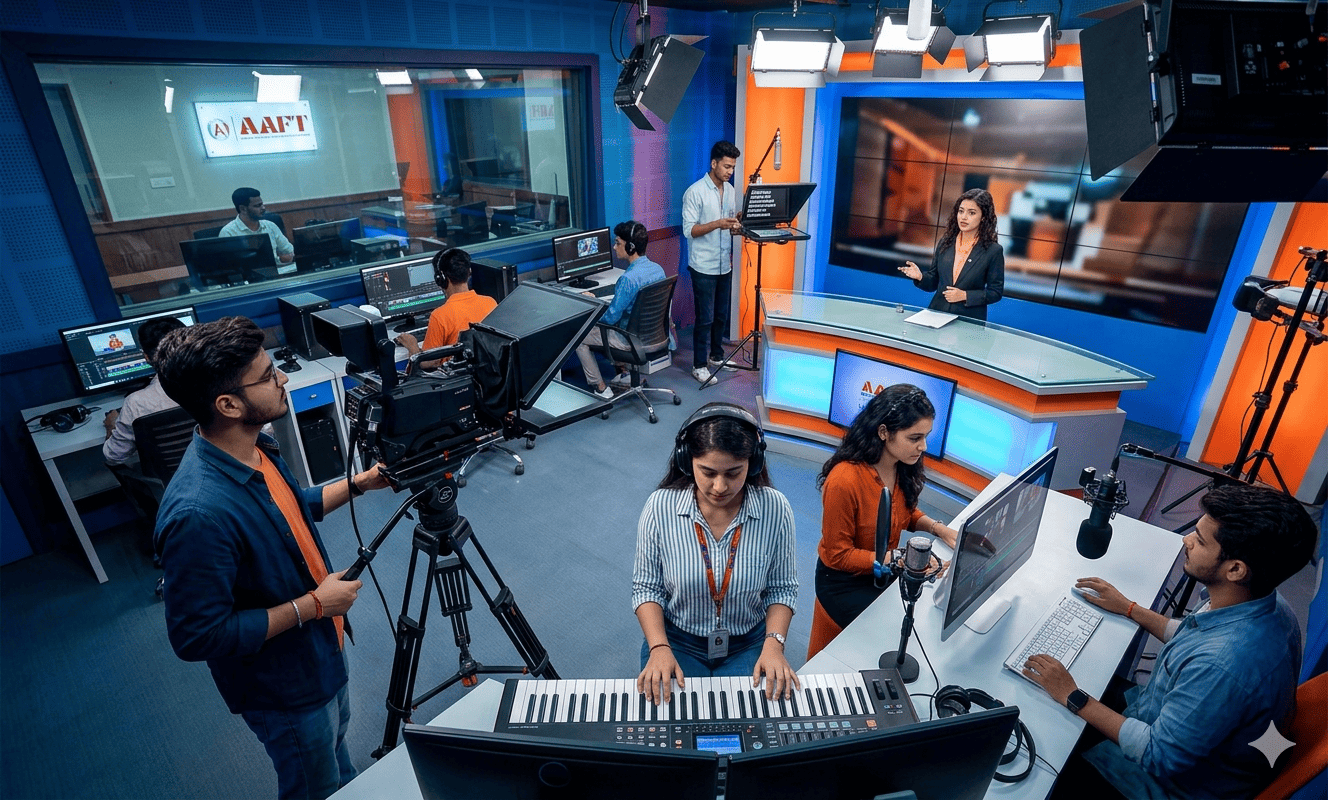
The program is far more than classroom instruction. Students gain hands-on access to in-house TV studios, a live radio station, post-production labs, and professional-grade cameras and editing equipment. Field reporting assignments, industry masterclasses, and live newsroom simulations form a core part of the curriculum, ensuring graduates enter the industry with real skills, not just a degree.
Mass Communication Courses After 12th: Your Entry Point
For students fresh out of school, this is arguably the most important decision point. Pursuing a mass communication course after 12th opens up multiple pathways, from certificate programs to full-fledged bachelor’s degrees.
Eligibility for most undergraduate programs requires a minimum of 50% aggregate marks in Class 12 from any recognised board. Notably, students from science, commerce, or arts streams are all eligible — media is one of the few fields that doesn’t restrict entry based on your 12th-grade subject combination.
At AAFT, the BAJMC program is open to all streams and runs over six semesters. Each semester progressively builds on the previous one, starting from fundamentals of communication and print media, moving into broadcast journalism, digital reporting, television production, and ultimately into advanced topics like media entrepreneurship and international media by the fifth and sixth semesters.
What You Learn: The AAFT BAJMC Curriculum
AAFT’s curriculum is continuously revised to stay aligned with current industry demands. Across six semesters, students cover:
Introduction to Mass Communication, Print and Publishing, New Media, Radio Theory and Practice, TV as a Medium, Public Relations, Reporting and Editing, Camera and Lighting Techniques, Television Production, Advertising, Video Editing and Sound Recording, Corporate Communication, Creative Advertising, and Media Laws and Ethics.
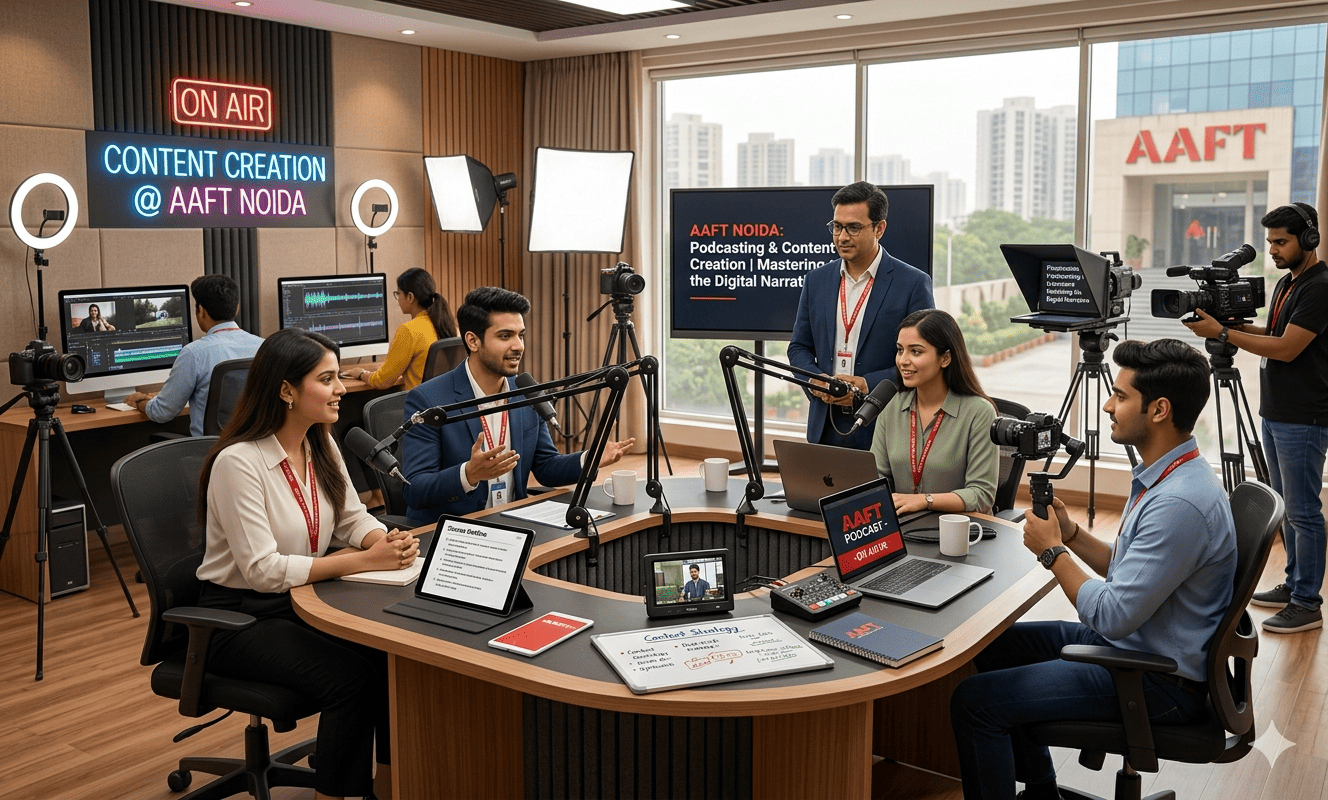
Beyond subjects, students participate in field reporting assignments, mock news broadcasts, radio shows, podcast production, and documentary projects. The program also incorporates internships, industry visits, and guest lectures from senior journalists, editors, and media executives.
AAFT’s Industry Dean for Journalism is Ms Kaveree Bamzai, the first woman editor of India Today, whose presence brings enormous credibility and mentorship value to the program.
Career Scope After a Mass Communication Degree
A strong B.A in Journalism and Mass Communication opens doors across a wide spectrum of media roles. Graduates from AAFT have gone on to work in:
Print and digital newsrooms, television channels and OTT platforms, radio stations and podcast networks, public relations and corporate communications, advertising agencies, content marketing, and independent journalism.
Top recruiters in the media industry include NDTV, Times Network, India Today Group, BBC, Star India, Network 18, Outlook, and All India Radio, many of which actively recruit from AAFT’s campus through job fairs and the institute’s dedicated CARE and EDGE placement cells.
The average starting salary in mass communication ranges from ₹3 lakh to ₹8 lakh per annum, with experienced professionals in senior editorial or broadcast roles earning significantly more.
Is the Fee Investment Worth It?
This is the real question every student and parent asks. The answer depends largely on the quality of education, infrastructure, and post-course outcomes the institute provides.
Paying lower fees at a college with minimal practical exposure often means graduates struggle to land roles, spend more time and money on additional training, and start their careers behind peers who attended more immersive programs.
AAFT’s fee structure is competitive precisely because it bundles real industry exposure like studios, labs, mentorship, and placement support into the program. The 100% placement support, industry masterclasses with working professionals, and access to a global alumni network are a rational one for students serious about media careers.
How to Apply to AAFT’s BA in Journalism and Mass Communication
Admission to the BJMC program at AAFT is straightforward. Students can apply online at aaft.com/pay-registration or visit the campus directly.
For queries, you can reach AAFT at 09811014536 / 09811013654 / 0120-4831100, or email help@aaft.com.
Admissions for the 2026 batch are currently open.
Final Thoughts
Understanding mass communication course fees is just the starting point. The real metric is return on investment — the quality of training, the relevance of the curriculum, the strength of industry connections, and the credibility of the institution behind your degree.
AAFT’s B.A. in Journalism and Mass Communication checks all these boxes. With over three decades of media education experience, a globally ranked position, state-of-the-art infrastructure, and dedicated placement support, it remains one of the most compelling choices for students who are serious about a career in journalism and media.


Team AAFT
AAFT has been providing the world with limitless creativity and expression since 1993! Through a dynamic and industry-driven curriculum, AAFT provides engaging and captivating articles to persuasive blogs and empowers its readers to explore diverse avenues of creative media education-related content.