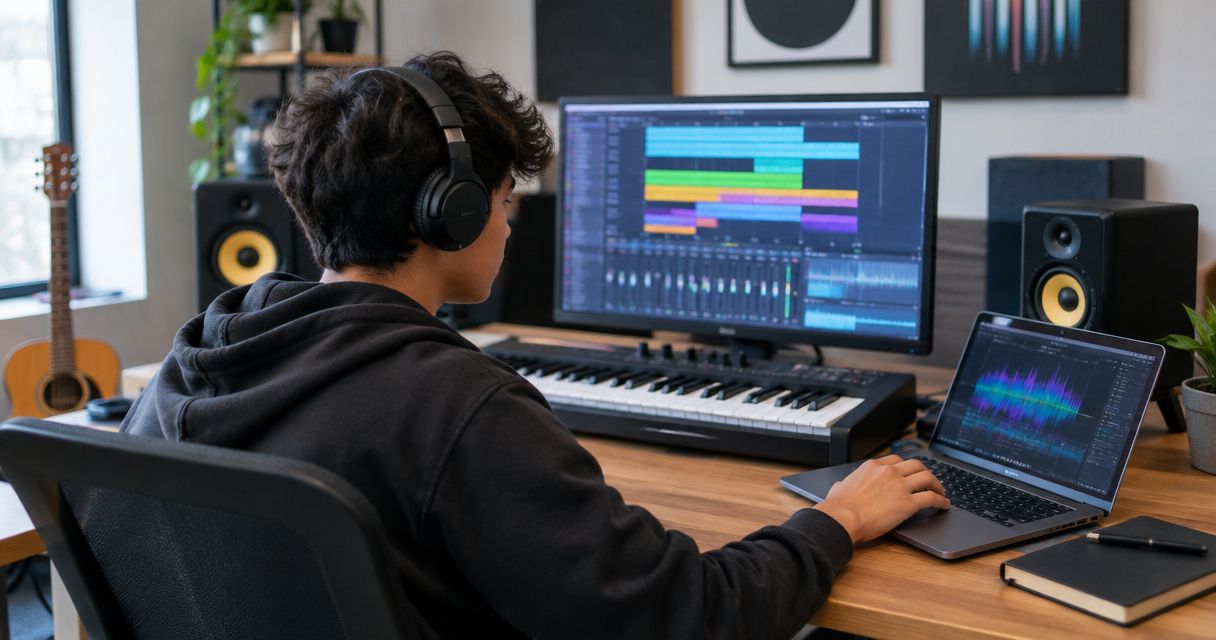
Best music production courses after 12th in Noida
Best overall for students seeking a degree: a degree route with a verified production curriculum. Best for focused training: a production-led diploma. Best for exploring the subject: a certificate. This 2026 guide compares music production courses after Class 12 for students considering campus study in Noida, including AAFT Noida.
- Compare music production courses by practical assignments, feedback, qualification and campus requirements—not course titles alone.
- Choose a degree route when earning a degree is central to your education plans.
- Choose a diploma for focused production study; choose a certificate to explore a defined skill.
- AAFT Noida suits prospective creative-education students seeking campus study; confirm the exact music programme before applying.
Why this matters
Looking for a degree pathway after Class 12? Explore AAFT’s B.Sc. in Sound Design to review its recording, music production, mixing and mastering outcomes, then submit an enquiry through the course page.
Music production is not the same as learning to sing, play an instrument or perform on stage. Production study concerns how you develop, record, arrange, edit and shape recorded music. A course with music in its title does not automatically give each of those activities equal attention.
After Class 12, your decision also concerns the qualification you will earn. A degree, diploma and certificate are distinct routes; do not treat them as substitutes simply because their descriptions mention similar software or studio activities.
Choose the qualification and the learning process together. A suitable course must match both what you want to study and how you intend to use that education.
What makes the best music production courses?
Use these criteria before comparing prospectuses for your 2026 application. Ask for programme-specific answers rather than relying on institution-wide descriptions.
- Qualification fit: Establish whether the award is a degree, diploma or certificate, who awards it, and what eligibility requirements apply.
- Production coverage: Look for explicit study of recording, arrangement, editing and mixing. Check how production differs from performance within the syllabus.
- Practical responsibility: Ask what you personally record, arrange and finish. Watching a demonstration is different from completing an assessed project.
- Feedback and revision: Establish who reviews your work, how feedback is delivered and whether assignments include revisions.
- Campus feasibility: Confirm attendance expectations, the teaching schedule and arrangements for accessing any facilities required by the programme.
- Evidence of learning: Ask what completed assignments demonstrate. A software list alone does not explain what you will learn to produce.
Avoid ranking courses by the length of their equipment lists. First establish whether students use the relevant equipment themselves and whether that work receives assessment.
Music production course routes at a glance
The ranking below is a decision guide for qualification routes, not a ranking of named institutional programmes. Confirm the exact course title, curriculum and award before selecting a route at any institution.
| Route | Best for | Main selection advantage | Key limitation |
|---|---|---|---|
| Degree route | Students whose education plans require a degree | Lets you evaluate production training within a degree qualification | The title alone does not establish the depth of production study |
| Diploma route | Students prioritising focused production study | Lets you select around a defined practical curriculum | A diploma must not be assumed equivalent to a degree |
| Certificate route | Students exploring production or a specific skill | Lets you assess a clearly bounded learning objective | A narrow syllabus does not establish broad production competence |
The best route depends on your objective, not on the order alone. A degree is the default only when you want a degree; a focused diploma deserves priority when its curriculum better matches your immediate learning goal.
1. Degree route: best for students who want a degree
A degree route suits students who want music production training alongside a degree qualification. Examine the actual balance between production, musicianship, theory and other subjects before deciding that the programme matches your interests.
Book Now →
For your 2026 shortlist, start with the award and work backwards to the timetable. Ask which modules involve making recorded music, which involve written study, and how each contributes to assessment.
Degree route pros
- Qualification alignment: It addresses an explicit goal to earn a degree rather than a different type of award.
- Curriculum visibility: A module-by-module syllabus lets you assess how production connects with the rest of the programme.
- Assessment comparison: Published assessment details let you distinguish practical projects from examinations or written submissions.
Degree route cons
- A music-related degree title does not establish that production is the main focus.
- Required subjects outside production must still fit your interests and education plans.
- Eligibility and any later study requirements need separate confirmation; never assume automatic progression.
Best for: Students who want a degree and can identify a programme with the production content they need.
Before enquiring, write down the work you want to learn: recording vocals, arranging songs, editing performances or mixing sessions. Use that list to interrogate the syllabus rather than asking whether the course is generally good.
Do you want free career counseling?
Ignite Your Ambitions- Seize the Opportunity for a Free Career Counseling Session.Verdict: Choose the degree route when the degree itself matters and the curriculum demonstrates sufficient production work.
2. Diploma route: best for focused production study
A diploma route deserves consideration when your priority is a defined production curriculum rather than earning a degree. The useful comparison is between assignments, assessment and learning objectives—not between qualification labels alone.
Ask where the programme begins and what students are expected to complete. A syllabus should make the progression from introductory tasks to more demanding work understandable without relying on promotional descriptions.
Diploma route pros
- Subject focus: You can judge the programme against a specific production-learning objective.
- Practical comparison: Assignment descriptions help you compare recording, editing, arrangement and mixing content directly.
- Clear boundaries: A defined syllabus helps you identify what the programme covers and what you would need to study separately.
Diploma route cons
- A diploma is not automatically interchangeable with a degree for further study or other qualification requirements.
- Focused production content does not establish coverage of performance, composition or broader academic subjects.
- The diploma label alone does not tell you how much independent practical work students complete.
Best for: Students who prioritise production skills and have checked that a diploma matches their qualification needs.
Request an explanation of a typical project from initial brief to final submission. Ask what you create independently, what happens in groups, and how individual work is assessed.
Verdict: Choose the diploma route when its verified assignments match your production goals and you do not require a degree from that programme.
Prefer focused production training? View AAFT’s Diploma in Music Production and submit the enquiry form to discuss eligibility, practical learning and attending the Noida campus.
3. Certificate route: best for exploring a defined skill
A certificate route suits a narrow, clearly stated learning objective. That objective might be understanding a production workflow or studying a particular part of recording and editing, provided the course actually lists that content.
For a beginner, the central question is whether the certificate teaches its stated subject from the required starting level. Do not assume that an introductory label removes all expectations around musical understanding or computer familiarity.
Certificate route pros
- Defined objective: A bounded syllabus makes it easier to judge whether the content matches a specific interest.
- Exploration: You can assess whether the subject interests you before deciding on a different qualification route.
- Targeted selection: You can compare courses around a particular learning gap rather than an entire discipline.
Certificate route cons
- A narrow course should not be treated as evidence of broad production training.
- A completion certificate does not automatically meet entry requirements for another programme.
- Coverage of a software application does not establish training in arrangement, listening or recording decisions.
Best for: Students who want to explore production or address a defined skill gap before choosing broader study.
Ask what you will be able to demonstrate at the end. A clear answer names an assessed task and its learning objective, rather than simply promising familiarity with professional tools.
Verdict: Choose the certificate route for a specific learning objective, not as an assumed replacement for a degree or diploma.
Exploring a certificate pathway? View AAFT’s Certificate in Music Production and enquire about the current duration, curriculum and eligibility before choosing this route.
How to assess practical training
A useful production assignment connects a creative decision with an audible result. Ask how a course teaches you to identify a problem, make a change, listen critically and explain the outcome.
Use this sequence when reviewing a 2026 syllabus:
- Create: What musical or recorded material do you produce yourself?
- Review: Who evaluates the work, and against which criteria?
- Revise: Do you apply feedback to the same project?
- Present: What do you submit, and how do you explain your decisions?

When discussing studio work, distinguish observation, group participation and individual responsibility. Each describes a different learning experience. Ask how the programme balances them and how your individual contribution becomes visible in assessment.
For software, ask about teaching objectives before asking about brand names. Knowing where a command sits is different from understanding why a recording needs an edit or why an arrangement feels crowded.
How to approach AAFT Noida admissions
AAFT Noida is best suited to prospective creative-education students seeking campus-based study in Noida. For music production courses, make your enquiry specific to the programme you intend to join rather than creative education in general.
For a 2026 admissions enquiry, prepare the following information and questions:
- Your education: State that you have completed or are completing Class 12, and request the exact eligibility requirements.
- Your preferred award: Specify degree, diploma or certificate so the discussion starts with the correct route.
- Your starting point: Describe any experience with music, recording or software without presenting it as an assumed admission requirement.
- Your learning goal: Identify the production activities you want to study and ask where they appear in the curriculum.
- Your campus commitment: Confirm that you intend to attend in Noida, then check scheduling and attendance requirements.
- Your application steps: Request the current selection process, required documents and confirmed intake information.
Confirm the relevant intake directly before making travel or study arrangements. Do not treat an earlier conversation about another programme as confirmation of the requirements for your chosen course.
Explore Your Music Course
Review the degree or diploma course page and submit an enquiry. Share your education, production interests and willingness to attend AAFT Noida so admissions can discuss your eligibility and study plans.
How these routes are ranked
The degree route ranks first for students whose plans include earning a degree. The diploma route takes the focused-study position, while the certificate route takes the exploration position.
This ranking uses qualification fit, curriculum clarity, practical responsibility and assessment as decision criteria. It does not assign scores to teaching quality, facilities or employment outcomes.
Which music production course should you choose?
Start with your required qualification, then choose the strongest curriculum match. If you want a degree, do not replace that goal with a diploma simply because both mention production software.
If qualification type is flexible, compare the practical work instead. Prefer the programme that clearly explains what you will create, how it will be assessed and how feedback supports revision.
For your 2026 decision, keep your final shortlist small enough to compare programme documents carefully. Resolve unanswered questions before applying, especially where a course title sounds broader than its listed content.
FAQ
What’s the best music production course after Class 12?
The best music production course matches your required qualification and practical learning goals. Choose a degree route if earning a degree matters, a diploma for focused study, or a certificate for a defined introductory objective.
Can I study music production after Class 12 from any stream?
Eligibility depends on the exact programme. Ask admissions to confirm accepted qualifications, subject requirements and any selection steps before applying.
Is a music production diploma better than a degree?
A diploma is the better fit only when its curriculum and qualification match your goals more closely. Do not assume that a diploma and degree are interchangeable for further study requirements.
Do I need to play an instrument before joining?
The relevant programme’s entry requirements determine whether prior instrumental experience is necessary. Explain your current experience and ask what musical knowledge the teaching assumes.
What should practical music production training include?
Practical training should connect creating work with assessment, feedback and revision. Ask which recording, arrangement, editing or mixing tasks you personally complete under the specific syllabus.
How do I enquire about music production courses at AAFT Noida?
Contact AAFT Noida with your education details, preferred qualification and production interests. Ask for the exact programme title, eligibility, curriculum, campus requirements and confirmed intake information.
Does completing a music production course guarantee a job?
Completing a course does not guarantee employment. Evaluate the qualification and learning opportunities without treating any course as a promise of admission to further study or a particular career outcome.
One last thing
Ask to discuss an assignment brief, not just a finished student project. A finished track shows an outcome; the brief explains the task, constraints and assessment behind it. That distinction helps you judge what the course actually expects you to learn.
Related guides