How to Become a Successful Actor: Acting Courses, Skills, and Eligibility
The old idea that acting is a “risky” career has faded fast. With OTT platforms, web series, and regional cinema multiplying roles every year, India now has a structured, credential-backed path into acting, one that starts with the right acting courses, not just talent. This guide walks through the exact roadmap: courses, eligibility, skills, portfolio-building, auditions, careers, and what it costs to get started.
Read Also: How Technology is Shaping the Future of Film Direction
How to Become an Actor: Step-by-Step Roadmap
Becoming an actor in India generally follows five steps:
- Step1: Build foundational skills through a structured acting course
- Step 2: Understand eligibility and complete admissions
- Step 3: Develop core performance skills (voice, movement, emotional range)
- Step 4: Create a portfolio and showreel, and
- Step 5: Start auditioning while gaining practical experience on real sets.
Each step builds on the last, helping you develop strong skills and a portfolio that showcases your talent, and it is this portfolio that can help you stand out and secure auditions.
Most aspiring actors underestimate how much the sequencing matters. Skipping training and going straight to auditions often means walking in without the necessary camera technique, audition etiquette, or even a reel to showcase your work.
The sections below break down each stage in detail, starting with the question every beginner asks: do you actually need a course to become an actor?
Read Also: Acting for Film, TV, and Web Series: The Degree That Opens All Doors

Acting Courses to Become an Actor
Everyone who has aspirations of being on-screen will get a taste of the different levels at which this will be possible. This means:
- Bachelor of Arts (BA) in Acting—This is a three-year undergraduate program that combines practical and theoretical acting courses.
- Diploma in Acting – It is a course that lasts for approximately one to two years with full practical learning as well as performance techniques.
- Postgraduate Diploma – It is for individuals who have already acquired a degree and covers high training in specialized areas in acting.
- Certificate courses are in the form of short-term programs designed for the beginners wanting an exposure to the fundamental fundamentals of acting.
Best Acting Courses After 12th
Once you’ve decided to pursue formal training, the next question is which type of course fits your goals and timeline. Acting courses after 12th generally fall into two categories: multi-year degree programs for deeper, industry-ready training, and shorter diploma or certificate courses for faster entry.
Degree Courses in Acting
A BA in Acting is typically a 3-year undergraduate degree combining performance theory with hands-on camera training, which is one of the most thorough route into a screen-acting career. AAFT’s BA in Acting for Film, TV and Web Series is structured this way, covering voice and diction, body movement, method acting techniques (Stanislavski, Meisner, Chekhov), camera acting, and a final semester built around a chroma shoot and a professional showreel project.
Book Now →
Students who want to go further can pursue a postgraduate route through the MA in Acting for Film, TV and Web Series after completing their degree.
Diploma & Certificate Acting Courses
Diploma and certificate courses in acting typically run from a few months to one year, offering faster, more intensive entry into screen performance for those who don’t want a multi-year commitment.
AAFT’s Diploma in Acting for Film and TV is a 1-year program following a 70:30 practical-to-theory model, covering Natya Shastra fundamentals, dance and movement styles, stunt and fight choreography, voice-over and dubbing, and a specialization track in the final semester. It’s suited to students who already have some performance background and want to move quickly toward auditions and industry work.
Do you want free career counseling?
Ignite Your Ambitions- Seize the Opportunity for a Free Career Counseling Session.Acting Course Eligibility & Admission Process
To be enrolled in the program, candidates have usually completed secondary education, or 10+2 examinations according to the norms of the respective boards; on aggregate, generally minimum 45%-50% standard according to the institution, while there may be an entrance examination [following] interviews/auditions. The candidates are encouraged to be passionate, motivated, and interested in theatre while the emphasis is kept on prior involvement in earlier theatrical activities.
Read Also: The 5 C’s of Cinematography: Secrets to Visual Storytelling
Essential Skills An Aspiring Actor Should Have
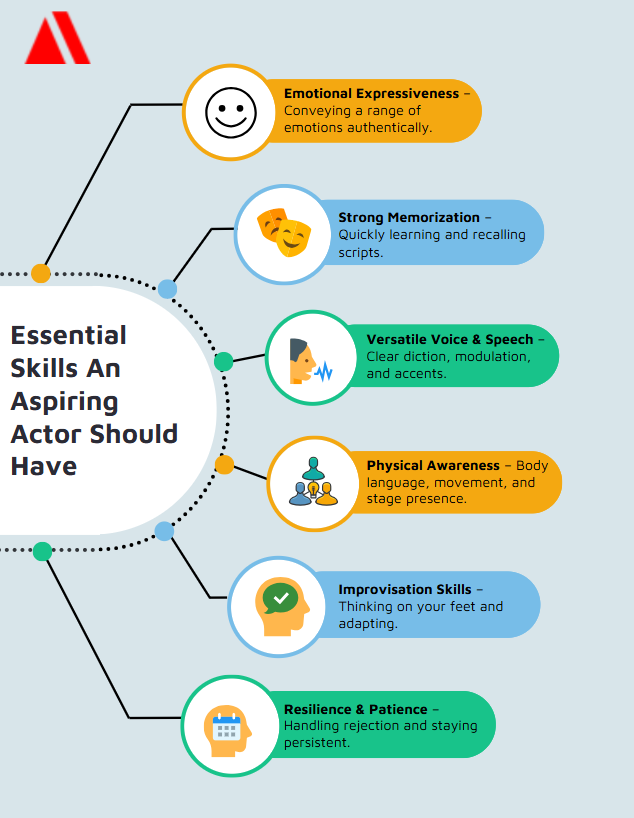
However, there is more to it than just a degree in acting. The most fundamental requirement is to have those essential skills developed. Among those are:
- Emotional Range: The ability to express several emotions with conviction.
- Voice Modulation: Mastery over the voice control to do different voices with the persuasion of different characters.
- Physical Acting: Knowledge of uses of body language and movement as part of characterization.
- Improvisation: It is the art of thinking on one’s feet, and adapting to whatever happens during the performance.
Practical Experience Through Local Productions
Formal education mostly lays the foundation, but with differing definitions of gaining practical experience, it goes without saying that aspiring actors need production experience. Local community theater productions or student films can assist aspiring actors in developing their craft. Eventually, they gain confidence, have good networking opportunities, and wait for more valuable work to develop. But also, these short productions could lead to small roles in major productions.
Read Also: Top 7 Acting Expressions That Every Actor Must Perfect
How to Build an Acting Portfolio & Showreel?
An actor’s portfolio should include professional headshots, a detailed resume of training and performances, and a demo reel or showreel showcasing your strongest on-camera work. It is often the first asset casting directors evaluate, which makes it essential for showcasing your skills and experience. Without a strong portfolio, even an impressive live-audition performance can be difficult to follow up on.
Most structured acting courses build portfolio development into the curriculum. AAFT’s BA in Acting includes practical opportunities to create audition-ready material throughout the acting course:
- Chroma Shoot: A final-semester chroma shoot provides experience in working with professional on-camera setups.
- Film Project: The final-semester film project gives students substantial footage that can be used for their portfolio and showreel.
- Monologue Shoots: Students practise and record monologues to build a collection of camera-ready performances.
- Scene-Work Shoots: Recorded scene work demonstrates acting ability across different characters, situations, and performance styles.
- Audition-Ready Portfolio: The combination of headshots, recorded performances, and film projects helps students develop material they can present when applying for auditions.
If you’re training independently, prioritise getting on camera as often as possible. Student films, local theatre, and self-shot monologues can all contribute to your first reel.
Acting Career Opportunities in Film, TV, OTT & Theatre
Trained actors in India can pursue roles across film, television, OTT platforms, theatre, commercials, voice-over work, and increasingly, digital content creation. The explosion of OTT and regional content since 2020 has meaningfully widened the number of paid acting opportunities beyond traditional Bollywood and television.
Common career paths after an acting course include:
- Film and television actor
- OTT and web series performer
- Theatre artist
- Commercial and advertisement actor
- Voice artist / dubbing professional
- Casting or script consultant
- Content creator and digital performer
Graduates of degree-level programs, such as AAFT’s BA in Acting, are also positioned to move into casting consultancy or further postgraduate specialization, while diploma graduates often move faster into stage shows, presenting, and TV hosting roles alongside acting work.
Acting Course Fees & Starting Salary in India
The acting course fees in India vary depending on the course type, duration, and institute. Students can choose between degree and diploma programmes based on their career goals and preferred level of training.
At AAFT, the B.A. in Acting for Film, TV & Web Series is a three-year undergraduate programme, while the Diploma in Acting for Film and TV is a one-year program. The approximate fee for the UG acting course is ₹8 lakh, while the Diploma course fee is around ₹2.2 lakh. The degree programme includes practical on-camera training, audition preparation, workshops, and industry exposure.
Starting Salary for Actors in India
The starting salary for actors in India does not follow a fixed range because earnings depend on the project, role, experience, portfolio, and production company. Beginners may start with smaller roles, advertisements, theatre projects, short films, or digital content before moving to larger film, television, and web-series opportunities.
Building strong acting skills, gaining practical experience, and developing an audition-ready portfolio can help aspiring actors improve their opportunities and earning potential over time.
Challenges Faced by Aspiring Actors
Though education might have an outlined path, an aspiring actor has to overcome many obstacles. The fight might be the fiercest one with the immense number of ambitious people who are competing for a few roles. What is more, to be constantly present and unafraid of the audition process is a challenge. Actors should learn a lesson from it and continue developing their skills through doing and getting feedback continuously.
Read Also: Mastering Post-Production: Tips and Techniques for Beginners
Conclusion
In today’s time, a degree in acting from India has become a bred-forth of various bright stages for aspirant performers. These programs deliver comprehensive training and practical experience to the students to make them efficient enough in today’s entertainment world. Essential skills are expected to be practiced, strong portfolios are supposed to be compiled and communities have to be actively interacted with by aspiring actors for better chances of success behind the camera.
Acting degree studies is not a blank slate as getting to know some stuff, but it is more of a development of personal qualities that will help you to become a successful actor in the modern film industry.
Also check out the AAFT Noida website for information on relevant courses with industry-standard curricula, exclusive industry experience, and top-of-the-line infrastructure.
Frequently Asked Questions
Q.1 Can I become an actor without an acting degree?
Yes. An acting degree isn’t mandatory, but formal training through a degree, diploma, or certificate course significantly improves camera technique, audition readiness, and industry access compared to going in untrained.
Q.2 Which course is best for acting after 12th?
It depends on your timeline: a 3-year BA in Acting offers deeper, more comprehensive training, while a 1-year diploma or shorter certificate course suits students who want faster entry into auditions and industry work.
Q.3 What is the eligibility for an acting course?
Most acting courses require 10+2 from a recognized board with a minimum of 45–50% marks, followed by an entrance test and an audition or personal interview; prior acting experience is generally not required.
Q.4 How do beginners find acting auditions in India?
Beginners typically start through institute-facilitated casting calls, local theatre productions, student and independent films, and casting platforms. These early opportunities provide practical set experience and help build the track record needed to move on to bigger auditions.
Q.5 How much does an acting course cost in India?
Costs vary by institute and course type, from subsidized government institutes to per-semester private program fees; check the specific institute’s official fee structure page for current figures rather than relying on third-party estimates.


AAFT Team
AAFT has been providing the world with limitless creativity and expression since 1993! Through a dynamic and industry-driven curriculum, AAFT provides engaging and captivating articles to persuasive blogs and empowers its readers to explore diverse avenues of creative media education-related content.